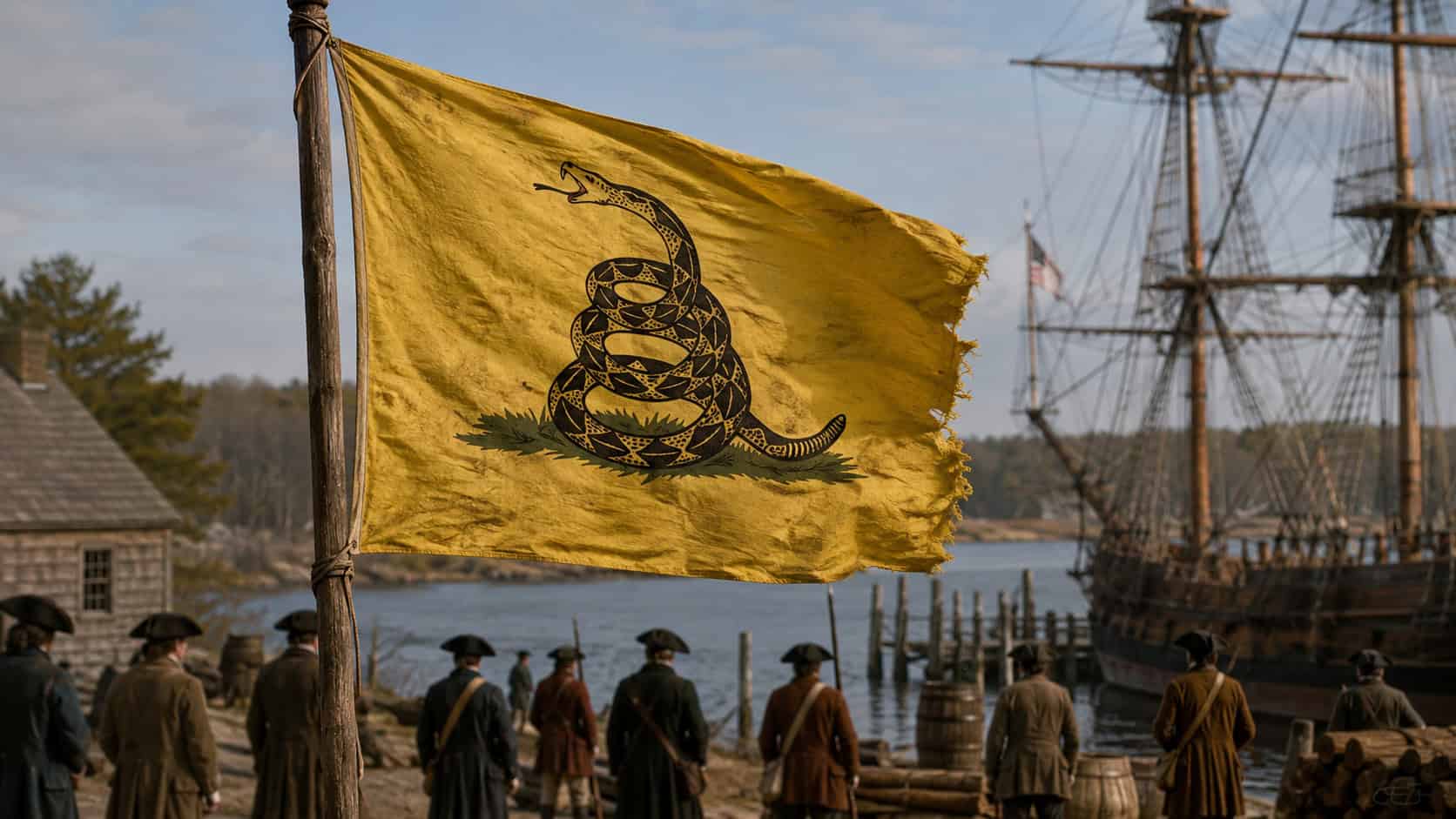
A yellow field. A coiled rattlesnake. Four words that have survived for more than two centuries: “Don’t Tread on Me.”
Few American symbols are as instantly recognizable as the Gadsden flag, yet its history is often compressed into a vague idea of rebellion. The original Don’t Tread on Me meaning was more specific. During the American Revolution, the rattlesnake became a warning against encroachment and a symbol of a people prepared to defend their liberties.
The flag emerged at a moment when the thirteen colonies were moving from resistance toward open conflict with Great Britain. Its message was not simply anger at authority. It expressed a distinctly defensive idea: leave our rights alone, and there is no reason for conflict. Step across that boundary, and expect resistance.
That history helps explain why the Gadsden flag remains visible on homes, clothing, vehicles, military-inspired gear, and public demonstrations today. Its modern uses vary, but the original story begins in the political symbolism of colonial America and the opening months of the Revolutionary War.
Quick Answer: What Does “Don’t Tread on Me” Mean?
Historically, “Don’t Tread on Me” was a warning against oppression and interference with American liberties. The coiled rattlesnake represented a defensive posture: capable of striking, but giving a clear warning before doing so.
The familiar yellow Gadsden flag is associated with South Carolina patriot Christopher Gadsden and was used during the opening period of the American Revolution.
The key idea: the flag originally communicated resistance to encroachment, self-defense, independence, and the determination to protect political liberty.
What Does “Don’t Tread on Me” Actually Mean?
To “tread” on something literally means to step on it. In the political language of the Revolutionary era, the phrase worked as a warning: do not trample on our liberties, rights, or independence.
The rattlesnake made that warning visual. Unlike a symbol built around conquest or attack, the coiled snake suggested readiness. It did not need to chase an opponent. It waited, warned, and defended itself when threatened.
That distinction matters because the Gadsden flag is sometimes reduced to a generic symbol of aggression. Its Revolutionary-era logic was closer to defensive resistance. The message was not “we seek a fight.” It was “do not force one by crossing this boundary.”
The power of the Gadsden flag comes from the combination of restraint and resolve: do not interfere with liberty, but do not mistake restraint for helplessness.
This idea fits naturally beside the broader principles Americans associate with the meaning of 1776 and American freedom. The Gadsden flag was one of several visual languages through which colonists expressed resistance before the United States had the national symbols we know today.
Why Did the Rattlesnake Become an American Symbol?
The rattlesnake was part of American political imagery before Christopher Gadsden’s famous yellow flag appeared.
One of the earliest and most influential examples came from Benjamin Franklin. In 1754, Franklin’s famous “Join, or Die” cartoon depicted a snake divided into sections representing colonies. The image urged colonial unity years before independence became the central political question.
The Library of Congress traces the rattlesnake symbolism further through colonial newspapers. In December 1775, an essay published under the name “American Guesser,” a pseudonym associated with Franklin, discussed the rattlesnake as an emblem of America and described the creature appearing on a Marine drum with the words “Don’t Tread on Me.”
By that point, the snake had evolved from a call for colonial unity into a broader symbol of American resistance. It was native to North America, visually distinctive, dangerous when provoked, and well suited to the political mood of 1775.
Who Was Christopher Gadsden?
Christopher Gadsden was a South Carolina merchant, political leader, soldier, and one of the most outspoken advocates of colonial resistance to British authority.
According to the National Park Service, Gadsden became a prominent defender of American political rights well before independence. He participated in the Stamp Act Congress in 1765 and later represented South Carolina in the First Continental Congress.
Gadsden was also an early advocate for creating a Continental Navy. That naval connection became important as Congress prepared for war and American vessels needed flags and signals of their own.
His political outlook made the rattlesnake an especially fitting emblem. Gadsden was not arguing for passive acceptance of British measures he considered violations of colonial rights. He favored organized resistance and greater American control over American affairs.
How the Gadsden Flag Appeared During the Revolution
By late 1775 and early 1776, the Continental Congress had begun organizing naval forces. Commodore Esek Hopkins became commander in chief of the Continental Navy fleet, and the yellow rattlesnake standard associated with Gadsden became connected with his command.
The Naval History and Heritage Command documents the clearest surviving evidence. On February 9, 1776, the journal of the South Carolina Provincial Congress recorded Gadsden presenting a yellow standard bearing a rattlesnake ready to strike and the words “DON’T TREAD ON ME.”
The record described it as the type of standard used by the commander in chief of the American navy. Naval historians also identify the yellow flag as a personal standard used by Esek Hopkins and designed by Christopher Gadsden.
That is the historical foundation of what Americans now call the Gadsden flag.
Its appearance came during the same revolutionary period explored in the story behind “We The People” and America’s founding principles, although the Constitution itself would not be written until more than a decade later. Both became enduring shorthand for larger American ideas long after the immediate events that produced them.
The Gadsden Flag and the First Navy Jack Are Not the Same Flag
This is where much of the popular history becomes confused.
The traditional Gadsden flag has a yellow field with a coiled rattlesnake and the words “Don’t Tread on Me.”
A different flag commonly called the First Navy Jack uses thirteen alternating red and white horizontal stripes with a rattlesnake stretched across them and the same motto.
Modern illustrations often imply that the striped rattlesnake flag was definitely the standard jack flown throughout the Continental Navy in 1775 or 1776. The surviving evidence does not establish that.
The Naval History and Heritage Command notes that contemporary records describe a Continental Navy jack as a “strip’d jack,” but no surviving contemporary document clearly says that the striped jack included either a rattlesnake or the “Don’t Tread on Me” motto.
There is abundant evidence that rattlesnakes and the motto appeared on Revolutionary-era flags, military equipment, and naval-related imagery. There is also solid evidence for Hopkins’s yellow Gadsden standard. What remains uncertain is whether the now-familiar striped rattlesnake design was actually the Continental Navy’s jack in the exact form commonly depicted today.
That distinction does not make the rattlesnake’s naval heritage fictional. It simply means good history requires separating what is firmly documented from what later tradition filled in.
Did the Modern United States Navy Fly a “Don’t Tread on Me” Flag?
Yes, although this later naval use should not be treated as proof of what every Continental Navy vessel flew in 1775.
In 2002, the Secretary of the Navy directed Navy ships to display the rattlesnake First Navy Jack in place of the union jack during the Global War on Terrorism. That practice continued until 2019.
The Navy returned to the 50-star union jack across the fleet on June 4, 2019. Under the restored custom, the First Navy Jack remained associated with the commissioned ship in active status having the longest total period of active service, other than USS Constitution.
This modern naval chapter strengthened the public association between the “Don’t Tread on Me” imagery and American military service, but it is separate from the unresolved historical question about the exact appearance of the Continental Navy’s original striped jack.
How Is the Gadsden Flag Different From the American Flag?
The Gadsden flag is a historic American political and military symbol, but it is not the national flag of the United States.
The Stars and Stripes represents the nation as a whole. The Gadsden flag communicates a more specific historical idea rooted in Revolutionary resistance, defensive liberty, and opposition to encroachment.
That is why the two flags can carry different emotional weight. The national flag speaks to the country, its people, its states, and the continuity of the republic. The Gadsden flag speaks more narrowly to a warning inherited from the Revolutionary generation.
Readers interested in that distinction can explore the broader meaning of the American flag as a symbol of unity and freedom.
What Does the Gadsden Flag Mean Today?
Historic symbols rarely remain locked to a single moment. Americans have reused Revolutionary imagery for generations, and the Gadsden flag is no exception.
Today, someone displaying the flag may be emphasizing individual liberty, limited government, resistance to concentrated power, constitutional rights, military heritage, or simply an identification with Revolutionary-era American history. The exact message depends heavily on who is displaying it and why.
That makes historical context more useful than assuming the flag has one automatic modern meaning.
The original symbol predates today’s political parties, modern ideological labels, and contemporary debates by centuries. Understanding where it came from does not require pretending that every later use carries exactly the same message. It means recognizing the foundation beneath those later interpretations.
Why the Rattlesnake Still Works as a Symbol
The Gadsden flag survived because its visual argument is remarkably simple.
The rattlesnake is alert. It occupies its ground. It gives a warning. It has the ability to defend itself. And it does not need a paragraph of explanation to communicate that posture.
For the Revolutionary generation, those qualities could be mapped onto colonies that believed Britain was crossing legitimate political boundaries. For later Americans, the symbol continued to offer a compact statement about liberty and resistance to unwanted interference.
That does not mean every use of the flag should be interpreted identically. It does explain why the design has lasted while thousands of other Revolutionary-era images disappeared from ordinary American life.
Why the Gadsden Flag Still Matters
The most useful way to understand “Don’t Tread on Me” is not as a modern slogan looking backward for historical decoration. It is the other way around. The phrase began as part of the language of the American Revolution and later generations kept finding new reasons to use it.
Its original meaning combined independence with restraint, warning with resolve, and liberty with the willingness to defend it.
That is also why historical symbols deserve context when they appear on modern clothing or gear. Wearing a symbol carries more weight when you understand where it came from. America 2 Wear explores that broader connection in the meaning behind patriotic apparel and American symbols.
The Gadsden flag does not tell the entire story of American liberty. No single flag can. But its coiled rattlesnake still carries one of the clearest warnings inherited from the founding era: freedom should not be treated casually, and neither should attempts to cross its boundaries.
Wear the Gadsden Symbol With Its History in Mind
The Gadsden rattlesnake has moved from Revolutionary flags and naval history into everyday American culture. For readers who connect with that history, these America 2 Wear pieces keep the original symbol recognizable while offering options for changing fall weather.
-

Patriotic Hoodies & Sweatshirts, 1776 & Constitution Apparel, Full Front Graphic Hoodies
Price range: $49.99 through $56.99Select options This product has multiple variants. The options may be chosen on the product page -

Rugged Trucker Hats, 1776 & Constitution Apparel
$29.99Select options This product has multiple variants. The options may be chosen on the product page -
Patriotic T-Shirts, 1776 & Constitution Apparel, Full Front Graphic Tees
Price range: $29.99 through $31.99Select options This product has multiple variants. The options may be chosen on the product page



Frequently Asked Questions About “Don’t Tread on Me” and the Gadsden Flag
What does “Don’t Tread on Me” mean?
Historically, “Don’t Tread on Me” was a warning against encroachment on American liberties. Paired with a coiled rattlesnake, the message suggested defensive resistance: do not interfere or threaten, because the person or people being warned are prepared to defend themselves.
Who created the Gadsden flag?
The yellow rattlesnake flag is traditionally and strongly associated with Christopher Gadsden, a South Carolina patriot, Continental Congress delegate, soldier, and advocate for American resistance. Historical records document a yellow rattlesnake standard presented by Gadsden to the South Carolina Provincial Congress in February 1776.
When was the Gadsden flag created?
The Gadsden flag emerged during the opening period of the American Revolution, around late 1775 and early 1776. A February 9, 1776, South Carolina Provincial Congress record describes Gadsden presenting a yellow standard featuring a rattlesnake and the words “DON’T TREAD ON ME.”
Why is there a rattlesnake on the Gadsden flag?
The rattlesnake had already become an American political symbol before the Gadsden flag appeared. Colonial writers and artists used the snake to represent unity, independence, vigilance, and resistance. Its ability to warn before striking also made it a powerful symbol of defensive resolve.
Is the Gadsden flag the same as the First Navy Jack?
No. The Gadsden flag normally refers to the yellow flag with a coiled rattlesnake. The design commonly called the First Navy Jack has thirteen red and white stripes with a stretched rattlesnake. Naval historians say the evidence is inconclusive that the Continental Navy actually used that striped rattlesnake design as its original jack.
Did the United States Navy use a “Don’t Tread on Me” flag?
Yes. In 2002, the Navy directed ships to fly the rattlesnake First Navy Jack in place of the union jack during the Global War on Terrorism. The fleet returned to the 50-star union jack on June 4, 2019, while retaining a tradition for the longest-serving active commissioned ship, other than USS Constitution.
Is the Gadsden flag the official flag of the United States?
No. The Gadsden flag is a historic American symbol, not the national flag of the United States. Its Revolutionary-era meaning is more specific than the Stars and Stripes, focusing on resistance to encroachment, defensive liberty, and independence.