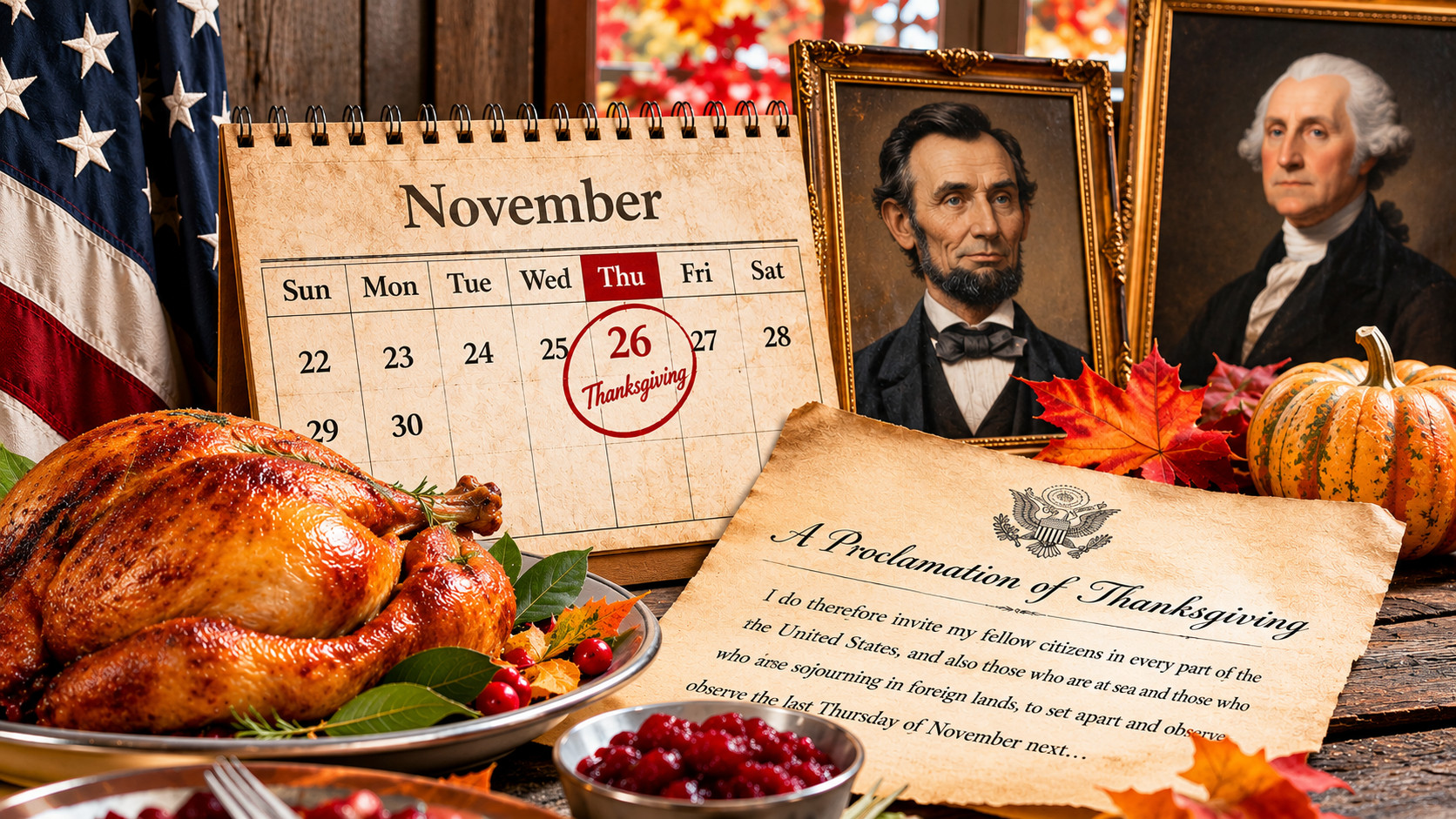
Why is Thanksgiving always on a Thursday when the date changes from year to year? The answer goes back much further than the modern holiday calendar. Thursday was already a familiar day for American thanksgiving observances, and Congress eventually made the fourth Thursday of November the permanent federal rule.
But that decision did not happen all at once. George Washington designated a Thursday in 1789. Abraham Lincoln established a national tradition around the last Thursday of November during the Civil War. Nearly eight decades later, Franklin D. Roosevelt tried moving the holiday earlier to help the economy.
Roosevelt’s change produced something that sounds impossible today: Americans in different states celebrating Thanksgiving on different dates. The dispute affected family plans, school schedules, football games, and the start of the Christmas shopping season.
To understand why Thanksgiving is on Thursday, and why it is specifically the fourth Thursday, it helps to separate the longstanding custom from the federal law that finally settled the date.
Quick Answer: Why Is Thanksgiving Always on a Thursday?
Thanksgiving falls on a Thursday because Thursday observances were part of American thanksgiving traditions long before the federal government established a uniform holiday. In 1863, Abraham Lincoln called for Thanksgiving on the last Thursday of November.
After a national dispute over the holiday’s timing, Congress passed a law in 1941 making the fourth Thursday of November the federal Thanksgiving holiday, beginning in 1942. That means Thanksgiving always falls between November 22 and November 28.
1. Was Thanksgiving Always on a Thursday?
No. Days set aside for thanksgiving existed in colonial America and the early republic, but they were not originally governed by one national date or weekday. Communities and political leaders proclaimed special days of prayer, reflection, and gratitude for different reasons and at different times of year.
Still, Thursday became a familiar choice in New England. The Massachusetts Commonwealth Museum’s account of Thanksgiving customs notes that Thursday was a market day in Plymouth and the Massachusetts Bay colony and also a day associated with public religious lectures. Those practices help explain why communities often selected Thursday, although there was no single colonial law establishing our modern Thanksgiving weekday.
It is also important not to work backward from today’s calendar. The 1621 Plymouth harvest gathering commonly associated with the early Thanksgiving story was not the beginning of a federally scheduled, fourth-Thursday holiday. That rule came centuries later.
2. George Washington and Early Thanksgiving Proclamations
One of the clearest early national milestones came in 1789, shortly after the Constitution took effect. On September 28, the first federal Congress asked President George Washington to recommend a day of public thanksgiving.
Washington responded with a proclamation calling for an observance on Thursday, November 26, 1789. The chosen date happened to be both the fourth and the last Thursday that November. It was a significant national observance under the new constitutional government, but Washington did not establish the annual fourth-Thursday rule used today.
Presidents and states continued to proclaim days of thanksgiving, sometimes on different dates and even in different months. For decades, the country’s thanksgiving practices were shared traditions rather than a completely standardized annual calendar event.
For a broader look at how those traditions developed, read our history of why Americans celebrate Thanksgiving.
3. Abraham Lincoln and the National Thanksgiving Tradition
The next decisive turning point arrived in 1863, during the Civil War. On October 3, President Abraham Lincoln issued a proclamation asking Americans to observe the last Thursday of November as a day of thanksgiving and praise.
Lincoln’s proclamation gave the holiday a recurring national pattern. Rather than leaving Americans to navigate a patchwork of different dates from year to year, the last Thursday became the familiar expectation for Thanksgiving in November.
Lincoln was not working in isolation. Sarah Josepha Hale, an influential editor and longtime advocate for a national Thanksgiving, had urged a shared observance. In a September 1863 letter to Lincoln, she specifically proposed the last Thursday of November. The date could serve as something Americans had in common even in a divided country.
There is a crucial difference between Lincoln’s practice and our present rule: the last Thursday is not always the fourth Thursday. In a November with five Thursdays, the last one is the fifth. That difference eventually became a national controversy.
4. Why Franklin Roosevelt Moved Thanksgiving in 1939
In 1939, the traditional last Thursday of November landed on November 30. That left a relatively short period between Thanksgiving and Christmas at a time when many retailers counted on shopping after the holiday.
With the United States still struggling through the effects of the Great Depression, President Franklin D. Roosevelt wanted to give businesses another week of holiday sales. He designated Thursday, November 23, 1939, instead of November 30.
The practical idea created a surprisingly public dispute. Some governors followed the president’s date, while others retained the traditional last Thursday. Families crossing state lines could face different holiday schedules. Schools and football teams had already planned around the later date, and calendars printed in advance could become inaccurate.
Critics jokingly called the earlier observance Franksgiving. The nickname captured a debate that went beyond turkey dinners: Should an established national custom be shifted to improve commercial conditions, and who had the authority to decide?
Roosevelt’s experiment continued into the following years, but it did not produce the simple, nationwide agreement he had hoped for. The National Archives’ history of the Thanksgiving legislation documents how the competing observances led Congress to settle the question.
5. How Congress Settled It on the Fourth Thursday
Congress acted in 1941 to establish one consistent federal holiday date. At first, the House of Representatives approved a proposal using the last Thursday in November, which reflected the familiar Lincoln-era tradition.
The Senate changed the language to the fourth Thursday in November. That distinction mattered in years with five Thursdays: the holiday would no longer slide all the way to November 29 or November 30 simply because the month contained an extra Thursday.
Both chambers agreed to the final version, and President Roosevelt signed the resolution on December 26, 1941. The law took effect for Thanksgiving in 1942. Congress did not invent the Thursday custom; it established a clear rule for which Thursday Americans would observe as the federal holiday.
The wording remains part of federal holiday law today. Title 5, Section 6103 of the United States Code lists Thanksgiving Day as the fourth Thursday in November.
6. Why Thanksgiving Changes Dates Every Year
Thanksgiving changes its calendar date because the law follows a weekday position, not a fixed number. Christmas is always December 25. Thanksgiving is always the fourth Thursday of November, whatever numbered date that Thursday happens to have.
As the calendar advances from year to year, the first Thursday of November lands on a different date. Count forward three more Thursdays, and you have Thanksgiving.
- Earliest possible date: November 22.
- Latest possible date: November 28.
- What stays the same: the weekday, Thursday, and its position as the fourth Thursday of November.
That is why a Thanksgiving dinner may be on the 23rd one year and the 28th another, without any new presidential decision or change in the law.
7. Is Thanksgiving Ever on the Fifth Thursday?
Not under the modern federal rule. Some Novembers have five Thursdays, but Thanksgiving still falls on the fourth one. The fifth Thursday comes a week later and is not the federal Thanksgiving holiday.
Before the 1941 law took effect, however, following the last-Thursday tradition could put Thanksgiving on the fifth Thursday. The 1939 dispute makes the difference easy to see: November 23 was the fourth Thursday, while November 30 was the fifth and last.
This is the simplest way to remember the history: Lincoln made the last Thursday the national custom; Congress made the fourth Thursday the permanent federal rule.
8. Why the Tradition Still Matters
The story of Thanksgiving’s date is a reminder that shared American traditions are shaped over time. Local customs came first, presidential proclamations gave them wider recognition, and federal law eventually made the timing consistent across the country.
That predictability matters. Families can plan reunions and travel, schools and workplaces can coordinate their calendars, and communities can prepare meals, service projects, and celebrations around a familiar day. The date serves the people who observe it, rather than being the purpose of the holiday itself.
Other American holidays have their own paths from local observance to national recognition. Our article on the history of Labor Day explores another example of how American customs became part of the national calendar.
Thanksgiving has changed in many ways since the eighteenth and nineteenth centuries, but its enduring center is recognizable: making time for gratitude, family, neighbors, and the responsibilities people share. The fourth Thursday gives that tradition a common place on the calendar.
Frequently Asked Questions About Thanksgiving on Thursday
Who decided Thanksgiving would be on Thursday?
No single person established the entire modern rule. Thursday observances were already familiar in early America. George Washington proclaimed a Thursday Thanksgiving in 1789, Abraham Lincoln established the last-Thursday tradition in 1863, and Congress set the fourth Thursday of November as the federal holiday in 1941.
Why is Thanksgiving the fourth Thursday instead of the last Thursday?
Congress selected the fourth Thursday in 1941 to create a consistent date after a dispute over moving the holiday earlier. In years with five Thursdays, the fourth Thursday comes one week before the last Thursday.
Why does Thanksgiving change dates every year?
Thanksgiving is tied to the fourth Thursday of November rather than a fixed calendar number. Because the weekdays shift from year to year, the fourth Thursday can fall on any date from November 22 through November 28.
Was Thanksgiving always celebrated on a Thursday?
No. Colonial and early national days of thanksgiving took place on various dates. Thursday became a familiar choice, especially in New England, but it was not originally a universal national rule.
What was Franksgiving?
Franksgiving was a nickname critics gave to President Franklin D. Roosevelt’s earlier Thanksgiving observance. In 1939, he chose November 23 instead of the traditional last Thursday, November 30, and different states ended up observing the holiday on different dates.
Did George Washington make Thanksgiving an annual holiday?
No. Washington proclaimed Thursday, November 26, 1789, as a national day of thanksgiving, but his proclamation did not establish a permanently recurring federal date. Lincoln’s 1863 proclamation started the enduring last-Thursday tradition, and Congress fixed the fourth-Thursday rule in 1941.
Has Thanksgiving ever fallen on the fifth Thursday of November?
Under the old last-Thursday custom, it could. November 30, 1939, was the fifth Thursday, and some states observed Thanksgiving that day. Under the federal law effective from 1942 onward, Thanksgiving is always the fourth Thursday, never the fifth.