Before the fireworks begin, before the grills are lit, and before another round of political arguments takes over the national conversation, Americans should stop and remember what July 4 actually represents.
It marks the adoption of a document that did more than announce a separation from Great Britain.
The Declaration of Independence stated a radical idea: human beings possess rights that no king, government, political party, or ruling class has the authority to casually take away.
In 2026, as the United States marks its 250th birthday, those words deserve more than a ceremonial reading. They deserve to be understood.
The Declaration of Independence Explained in Simple Terms
The Declaration of Independence says that people possess inherent rights, government exists to protect those rights, legitimate political power comes from the people, citizens may reform a government that betrays its purpose, and freedom requires courage, responsibility, and a willingness to defend the rights of others.
What Was the Declaration of Independence?
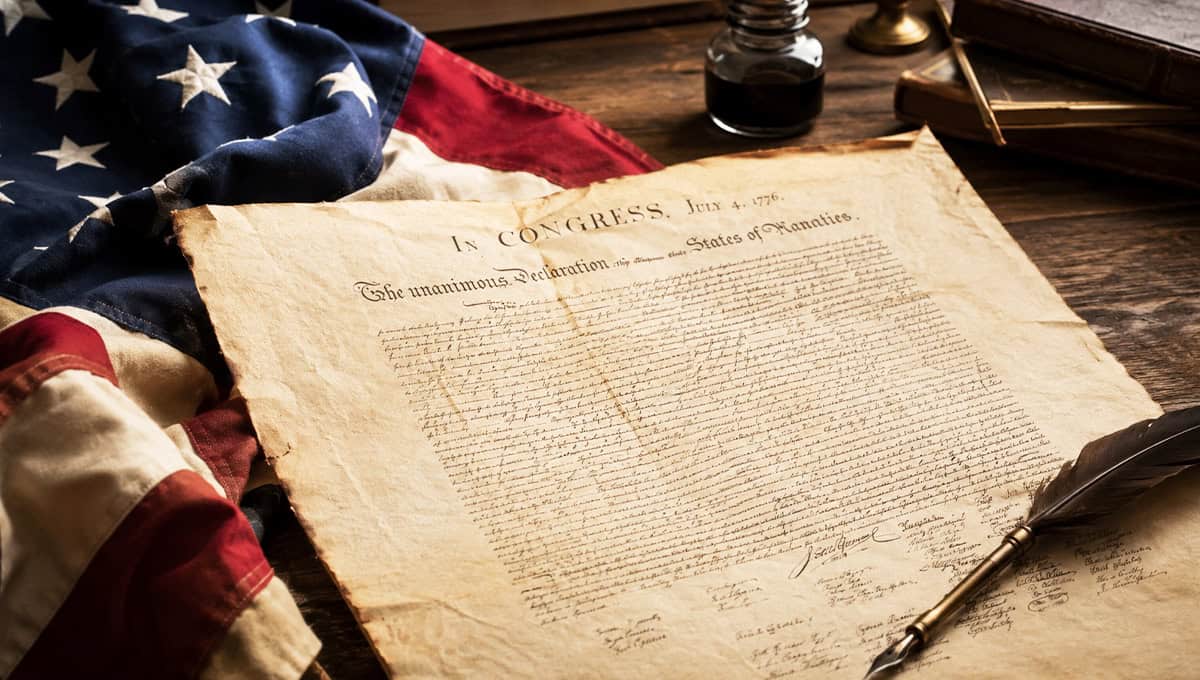
The Declaration of Independence was adopted by the Second Continental Congress on July 4, 1776. It formally announced that the thirteen American colonies considered themselves free and independent states rather than subjects of the British Crown.
Congress had actually approved the resolution for independence on July 2. The final wording of the Declaration was adopted two days later, and most delegates signed the formal parchment copy beginning on August 2.
Thomas Jefferson prepared the principal draft as part of a five-member committee that also included John Adams, Benjamin Franklin, Roger Sherman, and Robert R. Livingston. Congress debated and revised the text before approving it.
The Declaration was not a constitution and did not establish the detailed structure of the new government. It explained why the colonies were separating from Britain and stated the principles upon which the new nation claimed its right to exist.
You can read the complete document through the National Archives’ Declaration of Independence transcript.
For more background on the anniversary, read our guide explaining how old America is in 2026 and why the 250th birthday matters.
1. Rights Are Not Gifts From Government
The first idea Americans should understand is also the most important: our fundamental rights do not begin with government.
The Declaration says that people are created equal and possess “unalienable Rights,” including “Life, Liberty and the pursuit of Happiness.”
That language places a limit on political power.
A king does not create those rights. A president does not create them. Congress does not create them. A court does not create them. Government may recognize, protect, violate, or fail to defend those rights—but it is not their original source.
This was a direct rejection of the idea that ordinary people existed beneath a permanent ruling class. The colonists were declaring that political authority had boundaries and that human dignity came before government power.
That principle remains essential today.
Freedom of speech does not matter only when the speaker agrees with us. Religious liberty does not belong only to the largest faith. Due process does not exist only for popular defendants. The right to peacefully assemble does not disappear because those assembling hold different political views.
A right that exists only when powerful people approve of its use is not much of a right.
Americans do not have to agree on every law, policy, candidate, or cultural question. But a free nation must remain united around the principle that basic rights belong to every citizen—not only to our own side.
-

Patriotic T-Shirts, 1776 & Constitution Apparel, American Eagle & Flag Apparel, Full Front Graphic Tees
Price range: $29.99 through $33.99Select options This product has multiple variants. The options may be chosen on the product page

2. Government Answers to the People
The Declaration states that government receives its legitimate authority from the “consent of the governed.”
In plain English, government works for the people.
Citizens do not exist to serve politicians. Elected officials are not royalty. Government agencies are not masters standing above the public. Political power is temporarily entrusted to officials so they can protect rights, administer laws, provide public order, and carry out responsibilities authorized by the people.
That idea is the foundation of American self-government.
It means elections matter. Local meetings matter. Jury service matters. Honest public debate matters. Contacting representatives matters. Learning what a proposed law actually says matters. Holding officials accountable—regardless of party—matters.
Self-government cannot survive when citizens surrender all responsibility and expect a distant political class to handle everything for them.
It also cannot survive when people treat a political leader like a king who must never be questioned.
America was not founded to replace one unquestionable ruler with another. It was founded on the belief that government remains accountable to the citizen.
Politicians may hold office, but the country does not belong to them.
It belongs to the people.
3. Freedom Requires Courage and Accountability
The Declaration was not an emotional social media post. It was a serious public argument presented to the world.
The document stated its principles, listed a long record of grievances against King George III, described previous attempts to seek relief, and explained why separation had become necessary.
The colonists did not claim that governments should be overturned over every disappointment or temporary dispute. The Declaration specifically acknowledged that long-established governments should not be changed for minor or passing reasons.
That distinction still matters.
Freedom does not mean lawlessness. It does not mean destroying institutions whenever an election produces an unwanted result. It does not mean replacing debate with threats or treating every political disagreement as proof of tyranny.
Real self-government requires evidence, patience, lawful action, moral courage, and public accountability.
The men who approved independence understood that their decision carried enormous risk. They were challenging one of the most powerful empires in the world without knowing whether their new nation would survive.
They ended the Declaration by pledging their lives, fortunes, and sacred honor to one another.
That was not empty language. Independence would require years of war, sacrifice, loss, uncertainty, and perseverance.
Freedom has never been free of responsibility. Every generation inherits both the rights secured by those before it and the obligation to preserve them for those who come next.
4. Equality Was a Promise America Had Not Yet Fulfilled
An honest explanation of the Declaration of Independence cannot ignore the contradiction at the center of early America.
The document proclaimed that “all men are created equal,” yet slavery remained legal. Many of the rights proclaimed in 1776 were not fully extended to enslaved people, Native Americans, women, or citizens without property.
That failure does not make the principle of equality meaningless.
It makes the principle an unfinished promise—and a standard by which the nation could be challenged.
Generations of Americans used the country’s founding language to demand that America live up to its own declaration. Abolitionists appealed to its principles. Abraham Lincoln placed equality at the center of his understanding of the nation. The women who gathered at Seneca Falls in 1848 modeled their Declaration of Sentiments after the Declaration of Independence as they demanded civil and voting rights.
The Library of Congress documents how the Declaration influenced the early women’s rights movement.
America’s story is not one of instant perfection.
It is the story of a country forced, generation after generation, to confront the distance between its highest ideals and its actual conduct.
Patriotism does not require pretending that America never failed.
Real patriotism requires believing that America’s founding promise is worth keeping—and having the courage to correct the country when it falls short.
-
Patriotic Hoodies & Sweatshirts, 1776 & Constitution Apparel, American Eagle & Flag Apparel, Full Front Graphic Hoodies
Price range: $49.99 through $56.99Select options This product has multiple variants. The options may be chosen on the product page

5. Independence Is a Responsibility Passed to Every Generation
The Declaration did not promise that liberty would maintain itself.
A free country survives only when citizens understand what they have inherited and accept responsibility for protecting it.
That responsibility includes more than voting once every few years.
It means learning history instead of accepting whichever version best supports our political side. It means defending constitutional rights even when they protect someone we dislike. It means teaching children that citizenship includes both freedom and duty.
It means building strong families, businesses, neighborhoods, churches, civic organizations, and local communities that do not wait for Washington to solve every problem.
It means helping a neighbor, respecting lawful disagreement, supporting those who defend the country, and refusing to allow politicians or media personalities to convince us that fellow Americans are automatically our enemies.
Unity does not require Americans to think alike.
It requires us to remember that disagreement does not erase our shared citizenship.
Our country is strongest when free people can argue, debate, worship, work, build, vote, create, protest, serve, and still stand together beneath the same flag.
What the Declaration of Independence Does Not Mean
The Declaration is sometimes reduced to a collection of famous phrases. Understanding it also requires recognizing what it does not say.
- It does not say freedom means living without laws. Ordered liberty depends on laws that apply fairly and protect the rights of citizens.
- It does not say every political loss is tyranny. Free government includes elections, debate, compromise, legal challenges, and peaceful transfers of power.
- It does not belong to one political party. The Declaration predates America’s current parties and stands above campaign slogans.
- It does not claim America would be perfect. It establishes ideals against which the nation and its government can be measured.
- It does not separate rights from responsibility. A country governed by its people depends on informed, involved, and principled citizens.
Why the Declaration Still Matters 250 Years Later
On July 4, 2026, the United States celebrates 250 years since the Declaration of Independence was adopted.
There will be parades, fireworks, concerts, cookouts, speeches, merchandise, television specials, and political ceremonies.
Celebrate them. Fly the flag. Gather the family. Invite the neighbors. Teach the children. Honor the veterans and service members who defended the nation. Read our guide to organizing an America 250th anniversary neighborhood block party that brings people together.
But do not allow the meaning of the anniversary to disappear beneath the noise.
America’s 250th birthday is not simply a celebration of how long the country has existed.
It is a test of whether Americans still understand why it exists.
Do we still believe that rights belong to the people?
Do we still believe that government must remain accountable?
Do we still have the maturity to disagree without hatred?
Do we still believe freedom is worth defending—not only for ourselves, but for people whose beliefs, backgrounds, and politics differ from our own?
Those questions matter more than any fireworks display.
America Belongs to the People
America’s 250th birthday does not belong to Washington.
It does not belong to Republicans or Democrats. It does not belong to political campaigns, television commentators, corporations, or people who profit from keeping Americans angry at one another.
It belongs to the people.
Before there were modern parties, platforms, and political media machines, there was a declaration that government answers to the citizen—not the other way around.
America belongs to the people who wake up and go to work.
It belongs to the families raising the next generation, the veterans who carried its flag, the first responders who protect its communities, the workers who keep it moving, the business owners who build something from nothing, and the neighbors who still help one another when trouble arrives.
No politician owns the flag.
No party owns patriotism.
No generation is guaranteed the freedom it inherited.
Freedom must be understood. It must be exercised responsibly. It must be protected. And it must be passed forward.
That is the meaning behind the celebration.
That is the responsibility of America at 250.
Wear the Freedom. Carry the Responsibility.
At America 2 Wear, patriotic clothing is not about dressing for one holiday and forgetting the message the next morning.
It is about carrying American pride into everyday life.
When you wear 1776, the flag, the eagle, or the words that shaped this country, know what they represent. They stand for rights that do not come from government, power that belongs to the people, courage in the face of oppression, and a promise that every generation must work to uphold.
Learn more about the history and meaning of the American flag, explore our guide to patriotic apparel for America’s 250th birthday, or browse our collection of patriotic T-shirts created for Americans who wear their freedom with conviction.
Wear Your Freedom. Stand for the country. Hold the line.
Frequently Asked Questions About the Declaration of Independence
What is the Declaration of Independence in simple terms?
The Declaration of Independence is the document through which the thirteen American colonies announced their separation from Great Britain. It also explains that people possess inherent rights, government receives its authority from the people, and citizens may change a government that systematically violates its purpose.
What are the five main ideas of the Declaration of Independence?
Its central ideas are that people are created equal, people possess inherent rights, government exists to protect those rights, legitimate power comes from the consent of the governed, and people may reform or replace a government that becomes destructive of those purposes.
Who wrote the Declaration of Independence?
Thomas Jefferson prepared the principal draft. He served on the Committee of Five with John Adams, Benjamin Franklin, Roger Sherman, and Robert R. Livingston. The Continental Congress debated and revised the document before adopting it.
Why is Independence Day celebrated on July 4 instead of July 2?
Congress voted in favor of independence on July 2, 1776. It adopted the final wording of the Declaration on July 4, which became the date printed on the document and commemorated as Independence Day.
Was the Declaration of Independence signed on July 4, 1776?
No. The Declaration was adopted on July 4, but most delegates signed the formal parchment copy on August 2, 1776. Several others added their signatures later.
Is the Declaration of Independence a law?
The Declaration is not a legally binding governing document like the Constitution. It is a statement of principles, grievances, and political independence that explains the ideals upon which the United States claimed its right to exist.
What does “consent of the governed” mean?
Consent of the governed means that legitimate government authority comes from the people. Citizens grant officials limited power through constitutional systems, elections, and laws, and those officials remain accountable to the public.
Why does the Declaration of Independence still matter today?
It still matters because it states enduring principles concerning individual rights, equality, accountable government, and self-rule. Those principles continue to shape American civic life and provide a standard by which citizens can judge their government and their country’s progress.