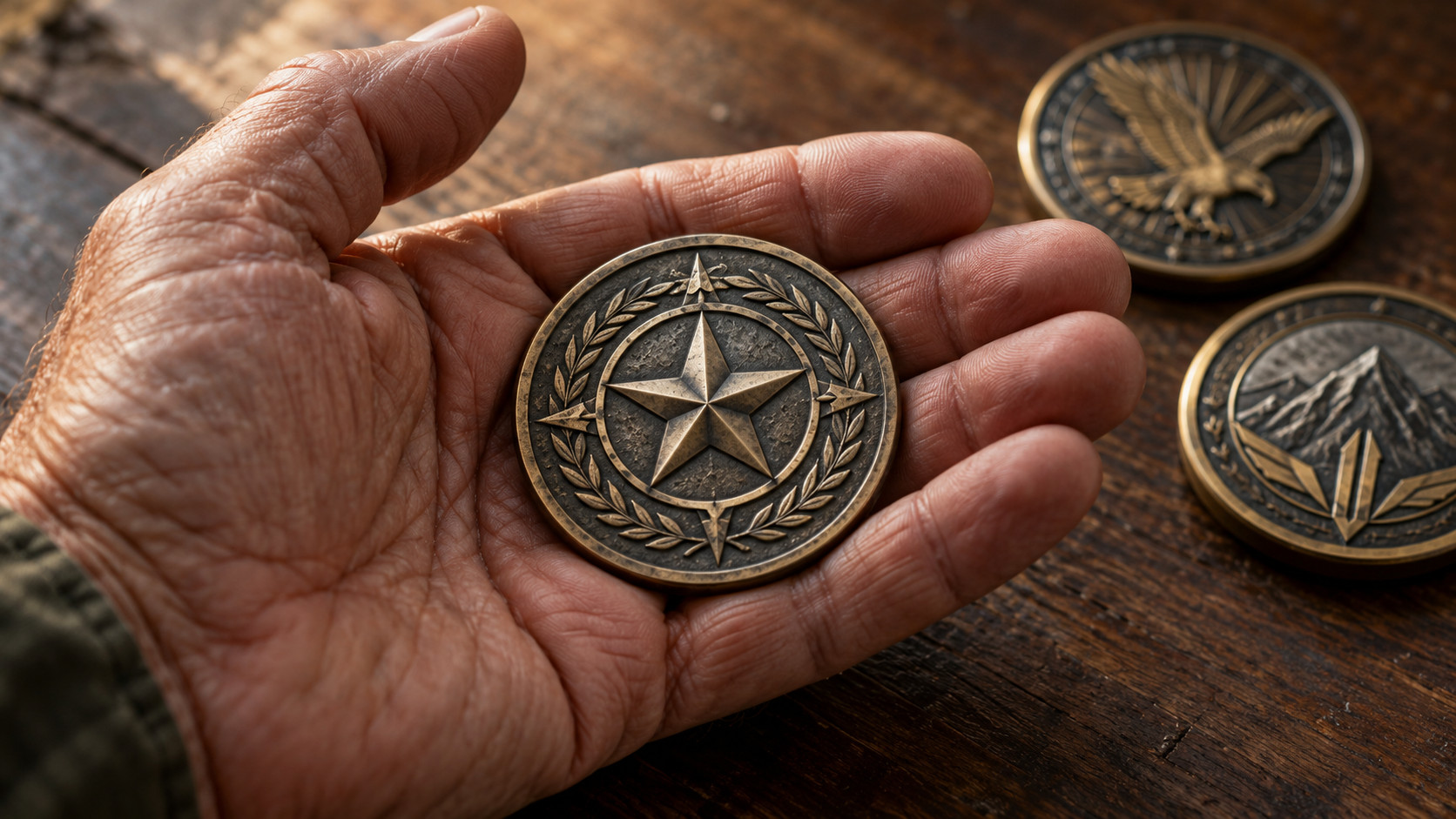
A military challenge coin may fit in the palm of your hand, but the meaning behind it can last a lifetime. For many service members and veterans, these small metal tokens represent moments of recognition, shared hardship, unit pride, and the people who stood beside them.
Unlike an ordinary collectible, a military challenge coin often carries a personal story. It might commemorate an assignment, recognize exceptional work, mark graduation from military training, or acknowledge a contribution that might otherwise go unnoticed.
Challenge coins have become familiar throughout the United States Armed Forces, but their history is less certain than many popular accounts suggest. Stories about their origins reach back to World War I, while other accounts describe traditions that developed during the Vietnam era and within Army Special Forces units.
So what exactly is a military challenge coin, why do people receive them, and what happens during a coin check? Understanding those questions reveals why a small piece of metal can carry such lasting significance.
Quick Answer: What Is a Military Challenge Coin?
A military challenge coin is a commemorative token associated with a military unit, organization, leader, mission, or achievement. It is commonly presented to recognize service, strengthen unit pride, or commemorate a meaningful experience.
History: Its exact origin remains uncertain. Several competing military traditions and historical accounts help explain how challenge coins became popular.
Meaning: The importance of a challenge coin usually comes from who presented it, why it was given, and the experience it represents, rather than its monetary value.
What Does a Military Challenge Coin Represent?
A challenge coin is often a physical reminder of belonging to something larger than oneself. It may carry a unit emblem, military insignia, organizational motto, commemorative design, or other imagery associated with a particular group or event.
Although different coins serve different purposes, several meanings appear repeatedly throughout military culture.
Recognition for Service and Achievement
Military leaders sometimes present challenge coins to recognize outstanding performance, extra effort, leadership, or meaningful contributions to a mission. This recognition can be especially memorable because it may be given personally and unexpectedly.
The United States Army describes challenge coins as tokens of appreciation that can acknowledge hard work and dedication. In some situations, the coin is presented directly by a commander or senior leader.
A challenge coin should not be confused with an official military decoration. It may carry considerable personal meaning, but it does not automatically confer the formal recognition associated with an authorized medal or award.
Unit Pride and Shared Identity
Many coins carry the identity of a particular military organization. Their designs may include unit insignia, aircraft, ships, military symbols, or references to a specific mission.
For a service member, that imagery can represent the people, responsibilities, and experiences associated with the unit. Two people holding the same unit coin may recognize a shared connection even if their individual experiences were different.
That sense of belonging explains why some veterans keep challenge coins long after leaving active service.
Personal Memories and Military Heritage
Some challenge coins commemorate graduations, deployments, anniversaries, special assignments, or changes of command. Others preserve the memory of a mentor, a respected leader, or a significant professional milestone.
In a 2023 United States Army account, an officer described how coins he received from people he mentored held particular importance because they represented relationships and experiences rather than simple collectibles.
A coin may have little value as raw metal while remaining personally irreplaceable to its owner.
Where Did Military Challenge Coins Come From?
The origin of military challenge coins is one of the most interesting parts of their history, partly because there is no universally verified starting point.
The United States Department of Defense examined the tradition and reported that historians and military research institutions could not identify written records establishing one definitive origin. Much of the early history survives through competing accounts and oral traditions.
Three explanations are especially common.
The World War I Pilot Legend
One of the most widely repeated stories concerns an American pilot serving during World War I.
According to the legend, a wealthy lieutenant had bronze medallions made for members of his flying squadron. Each medallion carried the squadron’s insignia.
One pilot supposedly carried his medallion in a small leather pouch. After being shot down and captured by German forces, he escaped but lacked conventional identification. When French soldiers mistook him for an enemy, he reportedly produced the medallion, allowing them to recognize his unit and spare his life.
The story concludes with squadron members adopting the practice of carrying their medallions as a form of identification and unit pride.
It is a memorable account, but the incident has not been established as the verified beginning of the challenge coin tradition. The Department of Defense identifies it as a popular explanation while acknowledging the lack of conclusive historical documentation.
The Vietnam-Era Coin Check Tradition
Another explanation connects challenge coins to informal military customs during the Vietnam War.
One account describes members of an Army infantry group using objects associated with their military experience to establish identity in a social setting. Over time, the practice reportedly shifted toward carrying specially marked unit coins.
This explanation is often connected to the coin-check tradition, in which someone challenges another person to produce a coin.
The Department of Defense has documented this account as another possible origin story, but it should not be treated as definitive proof that every modern challenge coin custom began in Vietnam.
Army Special Forces and the Growth of Unit Coins
A third account provides a more specific explanation for the spread of specially designed unit coins.
According to historical reporting discussed by the Department of Defense, members of the 11th Special Forces Group used existing coins marked with distinctive emblems during the early 1960s.
The account continues that the 10th Special Forces Group adopted the idea of having coins made specifically for its unit. The practice then became more widespread across the Army, particularly during the 1980s.
This version helps explain the development and expansion of unit-specific challenge coins, even though it does not settle the question of who created the first military challenge coin.
The historical takeaway: Challenge coins developed into an established American military tradition, but the surviving evidence does not support one completely certain origin story.
How Are Military Challenge Coins Given?
Challenge coins are often associated with personal recognition. A military leader may present a coin to someone whose performance, professionalism, initiative, or contribution deserves acknowledgment.
Some presentations occur during ceremonies. Others happen quietly during a meeting, inspection, visit, or informal conversation.
A frequently described custom involves the presenter placing the coin in the recipient’s hand during a handshake. However, this is not a universal requirement. Presentation practices vary among military organizations and individual leaders.
Challenge coins may also be distributed to commemorate participation in a course, assignment, event, or military organization. That means receiving a coin does not always indicate an individual award for exceptional achievement.
The distinction matters. Some coins are earned through recognition of particular accomplishments, while others are given as reminders of membership or shared experience. Both can be meaningful for different reasons.
What Is a Military Challenge Coin Check?
A coin check is a military social tradition in which someone produces a challenge coin and calls on others to show theirs.
The basic idea is straightforward: a participant who cannot produce an acceptable coin may be expected to fulfill a friendly penalty, traditionally purchasing a round of drinks or refreshments.
The United States Army describes this custom in its article Challenge Coins: More Than Just Metal.
How a Typical Coin Check Works
- Someone initiates the challenge. A participant presents or taps a challenge coin, according to the group’s custom.
- Others produce their coins. Anyone participating in the check is expected to show an acceptable challenge coin.
- The group determines the result. A participant without a coin may owe refreshments, depending on the established local rules.
- The custom remains social. The purpose is usually camaraderie, shared identity, and good-natured tradition rather than formal military enforcement.
There is no single universally binding set of coin-check rules across every branch, unit, or organization. Some groups have detailed customs, while others rarely conduct checks.
Anyone unfamiliar with the practice should follow the traditions of the group involved rather than assuming every internet rule applies everywhere.
Are Challenge Coins Official Military Awards?
Generally, no. A challenge coin is not the same thing as an officially authorized military medal, ribbon, or decoration.
A service member may receive a challenge coin in recognition of exceptional performance, but that does not automatically make the coin an official military award or an entry in a service record.
Likewise, owning a challenge coin does not establish that a person served in the military, belonged to a particular unit, or received a specific military honor.
Military-themed commemorative coins can also be purchased by civilians. Their appearance may resemble coins presented by military leaders, but their provenance and significance can be different.
For veterans and collectors, understanding how a particular coin was obtained is often more important than simply identifying the emblem on its surface.
Can Civilians Own or Receive Military Challenge Coins?
Yes. Although challenge coins are strongly associated with the military, ownership is not limited to active-duty personnel or veterans.
Military organizations and leaders may present coins to civilian employees, supporters, partner organizations, or individuals who have made meaningful contributions.
Challenge coins have also become popular with law enforcement, emergency services, community organizations, and other groups that value teamwork and recognition.
People can purchase commemorative or collectible challenge coins as well. However, buying one is different from receiving a coin in recognition of military service or personal achievement.
That distinction deserves respect. A commemorative coin can be a meaningful keepsake without becoming evidence of service or an honor its owner did not receive.
Why Do Veterans Keep Their Challenge Coins?
For many veterans, challenge coins provide a tangible connection to a period of life defined by responsibility, demanding work, and close relationships.
A coin might recall a first assignment, completion of difficult training, recognition from a respected commander, or a particular group of people who served together.
It can also preserve memories that are difficult to explain to someone who was not there.
A collection displayed on a shelf may look like an assortment of metal objects to a visitor. To the person who earned or received those coins, each one may represent a specific name, place, or chapter of service.
The value of a challenge coin is not measured by the metal it contains, but by the service, trust, and memories it represents.
These connections help explain why military challenge coins often remain important long after their original presentation.
They also fit within the larger American tradition of recognizing those who have served. Our guide to Veterans Day versus Memorial Day explains how the nation honors veterans and remembers those who died in military service.
How to Collect, Display, and Preserve Challenge Coins
Challenge coin collecting can begin with a single meaningful gift. Over time, some veterans and enthusiasts develop collections representing different military units, assignments, relationships, and historical interests.
Whether a collection contains three coins or several hundred, thoughtful handling can help preserve both the coins and the stories behind them.
Keep a Record of Each Coin’s Story
If a coin was presented by a leader or received during a significant event, consider recording the name, approximate date, location, and reason it was given.
That context may become more valuable than the coin’s appearance, especially when collections are passed down to family members.
Choose a Display That Fits the Collection
Display cases, coin racks, trays, and shadow boxes can help organize coins while keeping them visible.
For coins with significant sentimental or historical value, consider using archival-quality storage materials and keeping them away from excessive humidity, direct sunlight, and repeated handling.
Be Careful About Cleaning Valuable Coins
Challenge coins can have different metals, coatings, finishes, and painted or enamel details. Abrasive cleaners and polishing compounds may damage those surfaces.
When a coin’s materials are uncertain, gentle handling and suitable dry storage are safer starting points than aggressive cleaning. Particularly valuable or historically significant pieces may benefit from professional conservation advice.
Respect the Difference Between Collecting and Recognition
Military memorabilia can be a meaningful interest for civilians and veterans alike. Collecting should never require pretending to have earned an honor, served in a unit, or received a presentation that did not actually occur.
Respect for a coin’s history includes being accurate about its origin.
Are Challenge Coins Good Gifts for Veterans?
They can be, particularly when a coin commemorates something personal: a former unit, a deployment, a graduation, a retirement, or a meaningful relationship.
However, not every veteran associates challenge coins with the same experiences. Some may treasure them, while others prefer different reminders of their service.
If choosing a challenge coin as a gift, prioritize a genuine personal connection over a generic military design. A coin created to mark a family milestone or a specific shared experience may be especially meaningful.
For additional ideas that recognize military service without assuming every veteran has the same preferences, see our guide to patriotic gifts for veterans and proud Americans.
A Small Tradition With Lasting Meaning
Military challenge coins have evolved into a recognizable tradition across generations of American service members. Their designs, presentation customs, and personal meanings vary widely, but they share a common purpose: making recognition and belonging tangible.
The early history remains partly unresolved. The World War I pilot story, Vietnam-era social customs, and Army Special Forces accounts each contribute to our understanding without establishing one universally proven origin.
What matters most is often much simpler. Someone chose to recognize a person, commemorate a shared experience, or preserve a connection to a particular group.
For many who have served, that is what turns an ordinary piece of metal into something worth keeping.
Everyday American Heritage and Military-Inspired Style
Challenge coins are personal keepsakes, not fashion accessories. But the respect for service, unit identity, and American heritage behind them also finds expression in everyday clothing. For those who appreciate military-inspired and patriotic designs, America 2 Wear offers understated options suited to cooler weather and regular wear.
-

Patriotic Hoodies & Sweatshirts, American Eagle & Flag Apparel, Patriotic Hoodie Packs
Price range: $79.99 through $99.99Select options This product has multiple variants. The options may be chosen on the product page -

Patriotic Trucker Hats, American Aviation Apparel
$29.99Select options This product has multiple variants. The options may be chosen on the product page -

Patriotic Beanies, American Aviation Apparel
$24.99Select options This product has multiple variants. The options may be chosen on the product page



Frequently Asked Questions About Military Challenge Coins
What is the purpose of a military challenge coin?
A military challenge coin is commonly used to recognize service, commemorate an achievement, represent a unit, or preserve the memory of a shared experience. Its significance usually comes from the circumstances in which it was received.
Who started the military challenge coin tradition?
No single origin has been conclusively established. Popular accounts connect the tradition to a World War I pilot, Vietnam-era military customs, and Army Special Forces units during the 1960s. The Department of Defense has acknowledged the lack of definitive historical records identifying its beginning.
What happens if you lose a challenge coin check?
In some versions of the tradition, a participant who cannot produce an acceptable challenge coin is expected to buy refreshments for the group. Rules vary, and there is no universal coin-check procedure followed by every military organization.
Can someone who never served in the military own a challenge coin?
Yes. Civilians can purchase commemorative challenge coins or receive them from military organizations and leaders. Ownership alone does not establish military service, membership in a unit, or receipt of a military honor.
Are military challenge coins official awards?
Challenge coins are generally informal tokens of appreciation, unit identity, or commemoration rather than officially authorized military medals or decorations. Receiving one can still be a meaningful personal recognition of service or achievement.
Are military challenge coins worth money?
Some challenge coins have collectible or resale value based on factors such as rarity, condition, authenticity, and documented history. However, many recipients value their coins primarily for their personal meaning, and there is no single standard market value for all military challenge coins.
Is it appropriate to give a veteran a challenge coin as a gift?
Yes, especially when the coin has a personal connection to the veteran’s service, former unit, or important life event. A thoughtfully chosen commemorative coin can make a meaningful gift, but it should not be presented as an official award or personal recognition that the recipient did not receive.