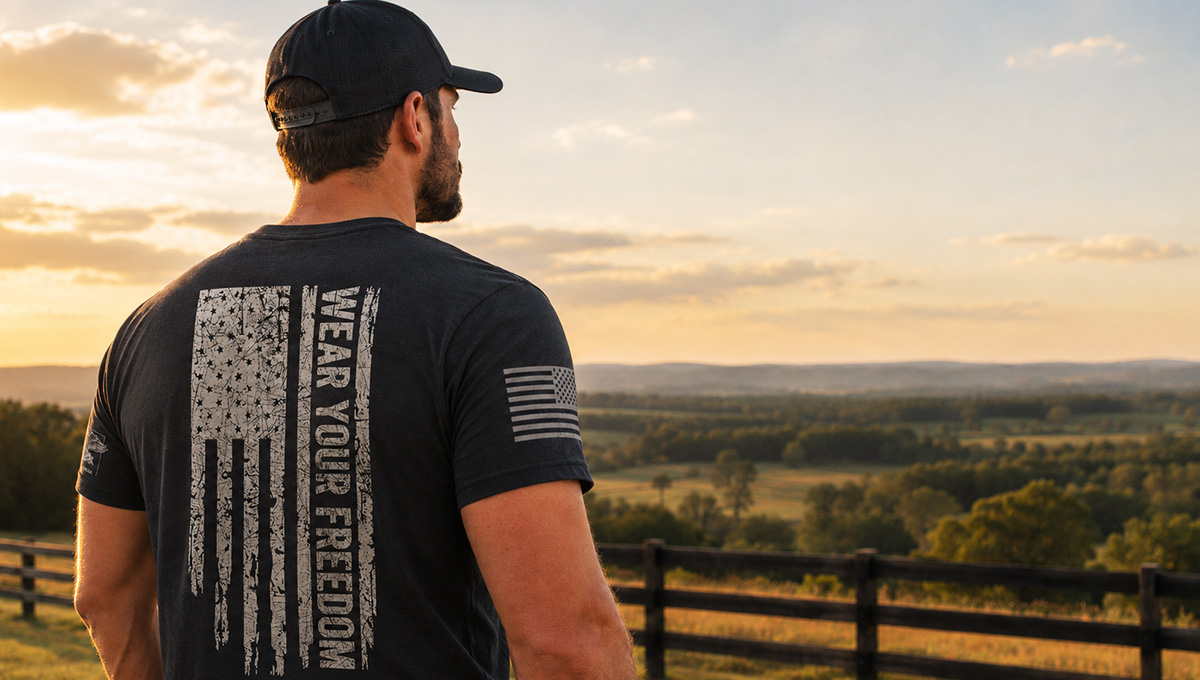
The American flag worn on the right sleeve of a military uniform is not backwards.
It is positioned so the blue field of stars faces forward—the same way the flag would appear if it were being carried into the wind as the wearer moved ahead.
That distinction matters.
The reverse American flag does not represent retreat, disrespect, or a careless design mistake. It represents forward movement. It represents a nation advancing under its colors. And it carries a message Americans should understand before rushing to call it wrong:
The flag is facing forward because America does not lead with the stripes. America leads with the stars.
So, why is the American flag backwards on military uniforms, aircraft, vehicles, and some patriotic clothing? Let us set the record straight.
The American Flag Is Not Actually Backwards
Most Americans are accustomed to seeing the flag displayed flat against a wall. In that position, the union—the blue field containing the stars—appears in the upper-left corner from the observer’s perspective.
That familiar wall display is correct. But a flag patch on the side of a moving person, vehicle, or aircraft follows a different visual principle.
Imagine an American flag mounted on a pole and carried forward. The edge attached to the pole remains at the front. The rest of the flag streams behind it in the wind.
Viewed from the left side, the union appears on the left. Viewed from the right side, the union appears on the right.
The flag did not change direction. Your viewing position changed.
That is exactly what the reverse flag patch represents. On the right shoulder, the stars are placed toward the front of the wearer while the stripes trail behind.
The United States Army explains that the star field should face forward, or toward the flag’s own right, creating the effect of the flag flying in the breeze as the wearer moves forward. The Army identifies the version used on the right shoulder as the reverse side flag.
Why Does the Star Field Face Forward?
The union is the position of honor on the American flag. It represents the states united as one nation under the Stars and Stripes.
When the flag is displayed on the right side of a uniform, placing the union toward the wearer’s front preserves that forward-facing position.
The stripes follow. The stars lead.
That is why the reverse American flag looks different from a flag hanging on a wall. A wall display is stationary. A sleeve patch represents movement.
It is not meant to look like a poster attached to someone’s arm. It is meant to look like a living flag carried forward by an American in motion.
The reverse flag does not show America moving backward. It shows the American flag advancing.
Why Is the Flag on the Right Sleeve?
On a right sleeve, the front of the wearer is located toward the observer’s right. Therefore, the union must appear on the right side of the patch to remain pointed toward the wearer’s direction of movement.
Using the familiar wall-display orientation on the right shoulder would place the stars toward the wearer’s back. Visually, that would make the flag appear to move in the opposite direction.
That is why the right-sleeve version is reversed.
On a left sleeve, the standard-looking orientation naturally places the union toward the front. On the right sleeve, the design must be mirrored to accomplish the same result.
The rule is easier to understand when you stop thinking in terms of left and right on the patch and start thinking in terms of one clear principle:
-

Patriotic T-Shirts, American Eagle & Flag Apparel, Full Front Graphic Tees
Price range: $29.99 through $33.99Select options This product has multiple variants. The options may be chosen on the product page
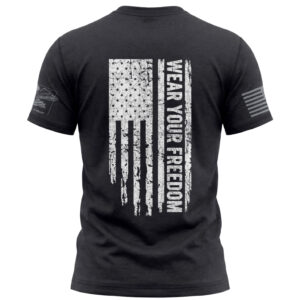
The stars face the direction of advance.
What Does the Reverse American Flag Mean?
The official explanation concerns proper orientation and the appearance of a flag moving forward. But the symbolism behind that position carries tremendous weight.
The American flag has gone forward with generations of service members. It has crossed oceans, landed on distant shores, stood watch at military bases, returned with fallen heroes, and risen over ground defended at an extraordinary cost.
It is not a decoration stripped of meaning.
It represents a living country. It represents the Constitution, the states, the people, and the hard truth that liberty must be defended by those willing to stand when standing is difficult.
The reverse flag communicates motion, readiness, and resolve. It reminds us that the Stars and Stripes do not belong behind the American spirit. They lead it.
Do “The Stars Never Retreat”?
You may have heard the reverse flag explained with the phrase, “The stars never retreat.”
That statement captures the spirit of the design, but it is best understood as a patriotic summary rather than the formal wording of the Army regulation.
The official explanation is that the star field faces forward and gives the appearance of the flag flying in the breeze as the wearer advances.
Still, the popular phrase endures because it expresses something Americans immediately recognize: the flag should not appear to run from the direction in which its bearer is moving.
Our country has known setbacks. It has made mistakes. It has faced division, war, hardship, and moments that tested whether the Republic could endure.
But the American ideal has always called us forward—to form a more perfect Union, defend liberty, correct what is wrong, preserve what is right, and hand the next generation a nation still worthy of the flag above it.
That is not blind patriotism.
That is patriotism with backbone.
Where Did the Reverse Flag Tradition Come From?
Long before embroidered patches appeared on modern uniforms, flags were carried into battle and in military formations.
The flag bearer held the colors high while advancing. As the formation moved forward, the flag streamed backward from its staff. Someone looking from the right side would see the union nearest the direction of movement and the stripes flowing behind it.
The modern reverse patch recreates that appearance.
The exact uniforms, patch requirements, and placement rules have changed across different eras, services, and uniform types. But the visual principle remains clear: the flag is oriented as though it is being carried forward.
It connects a modern sleeve patch to an older and deeper image—the American colors moving with those entrusted to defend them.
Why Do American Flags Look Backwards on Aircraft and Vehicles?
The same principle can be applied to moving vehicles and aircraft.
On the left side, the union may appear in the familiar upper-left position because that places it toward the front. On the right side, the design may be reversed so the union still points toward the nose or forward end of the vehicle.
The Smithsonian’s National Air and Space Museum explains this principle in its discussion of the American flag displayed on aircraft and spacecraft. The orientation is designed to make the flag appear as though it is flying with the craft rather than being dragged backward by it.
Again, the flag is not incorrectly printed. It is being viewed from the opposite side of a forward-moving object.
Is a Reverse American Flag Disrespectful?
No. A properly oriented reverse American flag is not disrespectful.
On the right side of a military uniform or moving object, reversing the design is done to preserve the forward position of the union. The intention is respect, not distortion.
Confusion usually comes from applying the rules of a stationary wall display to a patch representing a flag in motion.
There are displays of the flag that carry entirely different meanings. For example, an upside-down flag traditionally signals dire distress. A reverse flag is not an upside-down flag, and it does not communicate distress, surrender, or protest.
It communicates forward movement.
What Does the U.S. Flag Code Say About Flag Patches?
The United States Flag Code provides standards for respectful treatment and display of the flag.
It states that no disrespect should be shown to the flag and that the flag itself should not be used as wearing apparel. It also specifically recognizes flag patches affixed to the uniforms of military personnel, firefighters, police officers, and members of patriotic organizations.
The distinction matters. Wearing an actual flag as though it were a piece of fabric is not the same thing as wearing an embroidered or printed representation of the flag.
For everyday Americans wearing patriotic apparel, the right approach is not complicated: treat the symbol with respect. Do not drag it through the dirt. Do not treat it as disposable. Do not use it merely as a prop while mocking everything it represents.
Wear it because you mean it.
Can Civilians Wear a Reverse American Flag?
Civilians commonly wear American flag designs and reverse flag patches on shirts, jackets, hats, workwear, and outdoor apparel.
The reverse orientation itself does not falsely claim military service. It is a flag orientation. However, civilians should never use medals, branch identifiers, rank, unit insignia, or complete uniforms in a way intended to deceive others about service they did not perform.
Respecting military service means honoring the uniform without pretending to have earned it.
A simple reverse American flag on the right sleeve can be worn as an expression of national pride, unity, gratitude, and commitment to the freedoms Americans share.
Patriotism does not belong only to the government or the military. The country belongs to its people. But responsible patriotism respects those who carried its flag before us.
Which Way Should an American Flag Patch Face?
Use this straightforward guide:
- Left sleeve: The union should face forward, which normally places the stars on the observer’s left.
- Right sleeve: Use a reverse flag patch so the union faces forward, placing the stars on the observer’s right.
- Front of a shirt, jacket, or hat: Use the conventional orientation unless the design has a specific reason to represent movement in another direction.
- Right side of a vehicle or aircraft: The union typically faces the front of the vehicle, producing the reverse appearance.
- Flat wall display: The union belongs at the top and to the flag’s own right, which is the observer’s left.
Do not decide orientation solely by asking whether the patch looks familiar. Ask which direction the person or object is facing.
The union should lead.
Why America 2 Wear Uses the Reverse Flag on the Right Sleeve
At America 2 Wear, the reverse American flag on the right sleeve is not an afterthought. It is part of the identity behind our shirts and hoodies.
Our flag does not face backward because our country is not something we are trying to leave behind.
It faces forward because freedom demands forward motion.
America is not perfect. No nation built by human beings ever will be. But this country remains worth defending, worth improving, worth uniting, and worth representing without apology.
That belief is carried across our patriotic T-shirts, including our clean-front American flag sleeve T-shirt packs and our collection of patriotic hoodies and sweatshirts.
The right sleeve carries a simplified reverse American flag. The left sleeve carries the America 2 Wear mark and our call to action:
Wear Your Freedom.
That message is not about wearing a costume once a year. It is about keeping American pride in your regular rotation—at work, on the road, around the property, at the range, during a cookout, or on an ordinary Tuesday when the cameras are nowhere in sight.
Real values are not reserved for holidays.
For more on carrying American pride beyond Independence Day, read why every patriot needs an everyday T-shirt rotation. To learn more about honoring the Stars and Stripes, visit our guide to what Flag Day means and why it still matters.
The Flag Faces Forward Because America Must Keep Moving Forward
Now you know why the American flag looks backwards on the right sleeve.
It is not a printing error. It is not disrespect. It is not surrender.
The stars face forward because the flag is shown moving with its bearer. The union leads, the stripes follow, and the colors advance.
That is the meaning behind the reverse American flag.
It stands for a country that has been tested and still stands. A country built by workers, soldiers, parents, builders, farmers, first responders, entrepreneurs, and ordinary citizens who refuse to take liberty for granted.
America does not need empty praise. It needs people willing to protect its freedoms, remember its history, strengthen its communities, and hold the line when the principles of the Republic are challenged.
Face forward. Stand firm. Carry the flag with respect.
Wear Your Freedom.
Frequently Asked Questions About the Reverse American Flag
Why is the American flag backwards on military uniforms?
The American flag appears backwards on the right shoulder because the union, or blue field of stars, must face forward. This makes the flag look as though it is flying in the breeze as the service member moves ahead.
What is a reverse American flag?
A reverse American flag is a mirrored flag design commonly used on the right side of a uniform, vehicle, or aircraft. The stars appear on the observer’s right so they remain pointed toward the direction of movement.
Does a backwards American flag mean retreat?
No. It means the opposite. The reverse orientation places the stars toward the direction of advance, making the flag appear to move forward rather than retreat.
Is wearing a reverse American flag disrespectful?
No. A reverse flag placed on the right sleeve is a respectful orientation designed to keep the union facing forward. It should not be confused with an upside-down flag, which has a different meaning.
Which sleeve should an American flag patch go on?
Placement depends on the uniform or garment. When worn on the right sleeve, a reverse flag is used so the stars face forward. When worn on the left sleeve, the familiar orientation usually keeps the stars facing forward naturally.
Can civilians wear a reverse flag patch?
Civilians commonly wear reverse American flag designs as an expression of patriotism. They should wear the symbol respectfully and avoid using military ranks, medals, unit insignia, or complete uniforms to falsely imply military service.
Why do flags look backwards on airplanes?
On the right side of an aircraft, the stars face the nose so the flag appears to stream backward while the aircraft moves forward. The same forward-facing principle explains the reverse flag on a right sleeve.
What does “the stars never retreat” mean?
“The stars never retreat” is a popular patriotic explanation for the reverse flag. The formal Army explanation is that the star field faces forward, creating the effect of the flag flying as the wearer moves ahead.