When Americans see a flag lowered to half-staff, the message is unmistakable: someone is being honored, remembered, or mourned.
What is far less obvious is who ordered the flag lowered, which flag the order covers, and which flagpoles are actually affected.
There is no single state-level system used across America.
America 2 Wear reviewed official half-staff guidance across all 50 states, including governor policies, state statutes, executive-order archives, flag-status systems, government notices, and other primary state sources.
The result is a patchwork.
Some states maintain dedicated flag-status pages. Others publish orders through governor newsrooms or executive-order archives. Some gubernatorial directives reach state facilities statewide. Others can be limited to a county, district, Capitol complex, or specific location. Some states explicitly encourage residents and businesses to participate. And in certain states, the state flag and the United States flag do not always move together.
That distinction matters whether you are responsible for a flag at a public building, veterans organization, school, business, church, or your own home.
For the underlying state-by-state reference, see our 50-State Half-Staff Flag Rules & Official Sources.
Key Findings From the 50-State Review
Our analysis of the America 2 Wear 50-state directory found:
| Finding | States | Share of 50 States |
|---|---|---|
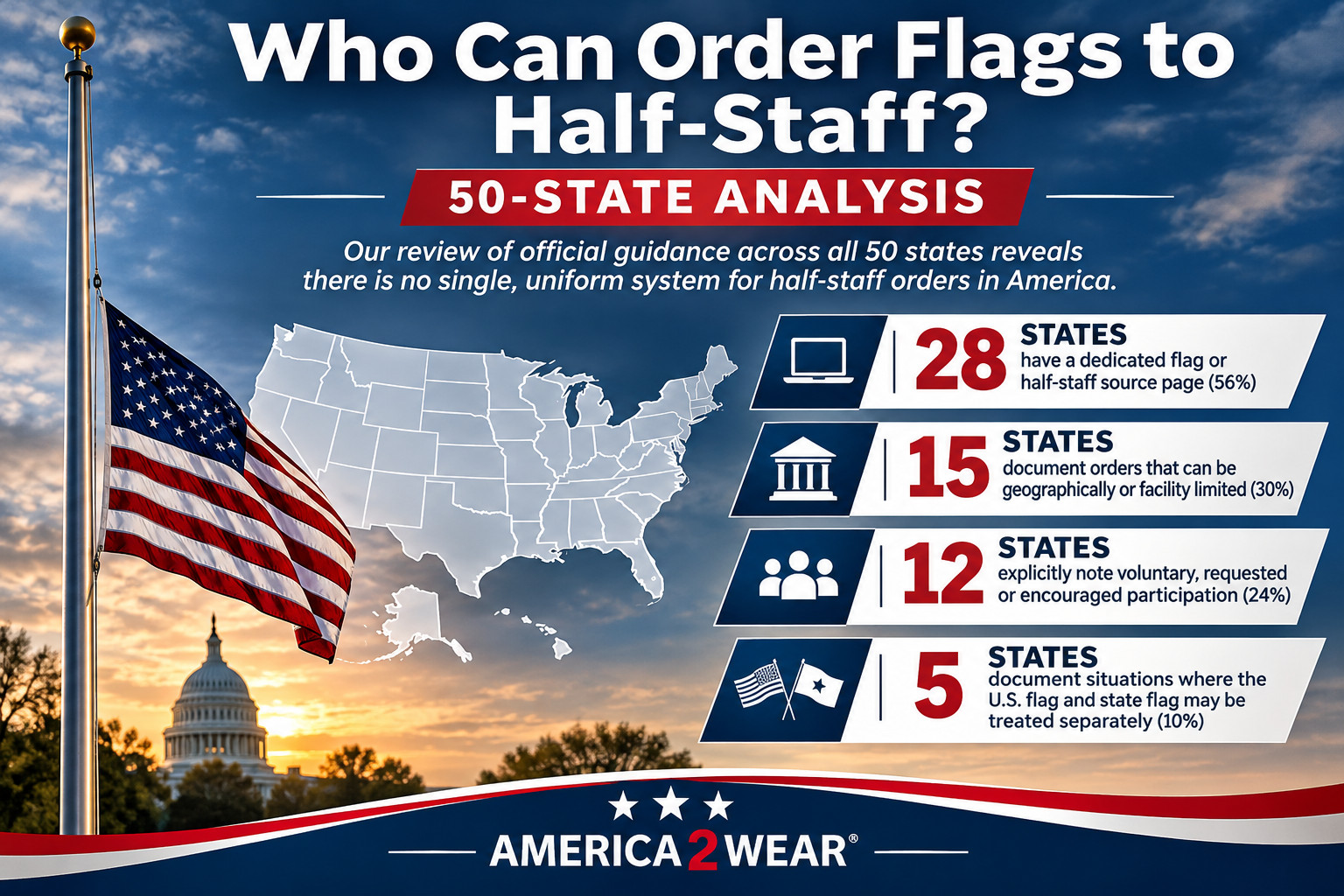
| Best official source is explicitly presented as a dedicated flag, half-staff, flag-status, flag-honors, or flag-policy resource | 28 | 56% |
| Directory explicitly documents orders that can be geographically or facility limited rather than simply statewide | 15 | 30% |
| Directory explicitly identifies voluntary, requested, invited, or encouraged participation outside directly covered state property | 12 | 24% |
| Directory explicitly identifies situations where the state flag and United States flag may be treated separately | 5 | 10% |
These categories describe what was explicitly documented in the sources reviewed for our directory. They should not be interpreted to mean that a state outside a category could never issue a similar directive.
The bigger finding is simpler:
Half-staff authority in America is not one uniform system. The issuer, flag, property, geography, and wording of the individual directive all matter.
1. Finding Official Half-Staff Information Is More Fragmented Than It Should Be
Of the 50 states in our directory, 28 had a best official source whose title was specifically devoted to flags, half-staff notifications, flag status, flag honors, or flag policy.
That means 22 states in our reference required a different route.
Depending on the state, a citizen may have to search:
- a governor’s newsroom,
- executive orders,
- state statutes,
- press releases,
- a broader governor website,
- or another government information system.
That difference might sound administrative, but it has practical consequences.
Someone responsible for raising or lowering a flag often needs an answer today, not after navigating several government websites trying to determine whether a press release applies to their property.
A dedicated flag-status system makes that easier. A scattered system makes it more important to identify the correct official source before acting.
That is one reason our 50-state directory links directly to the strongest official state source we located for every state rather than trying to replace those sources with a commercial flag-status service.
2. A Governor’s Half-Staff Order Is Not Always Simply “Statewide”
One of the easiest mistakes to make is assuming that a gubernatorial announcement automatically means every flag in the state must be lowered.
Our directory explicitly documents 15 states where official guidance or recent directives show that an order can be geographically or facility limited.
The limitation might involve:
- a particular county,
- a legislative district,
- a city,
- the State Capitol,
- a Capitol complex,
- selected state facilities,
- a political subdivision,
- or another specified location.
Maine provides one of the clearest statutory examples.
Under Maine law, the governor may authorize the United States flag and Maine flag to be flown at half-staff throughout a political subdivision or a specified location or locations.
That is very different from assuming that every gubernatorial order automatically applies to every flagpole from one state border to the other.
Other states in our directory also document narrower possibilities.
Indiana directives can be geographically targeted to particular counties or legislative districts. Missouri orders may identify counties or cities. South Dakota orders can distinguish between a statewide observance and one limited to the State Capitol. Wyoming has issued directives affecting only particular flags or locations.
The practical lesson is straightforward:
Read the scope of the actual directive.
The word “statewide” itself may refer to state-operated property rather than every privately owned flagpole in the state.
3. Government Orders and Private Participation Are Not the Same Thing
Another major distinction is the difference between direct authority over government property and encouraging the public to participate.
Our directory explicitly identifies 12 states where official guidance mentions voluntary, invited, requested, or encouraged participation outside the state property directly covered by the order.
Texas is a strong example.
Texas guidance states that, in addition to state agencies, individuals, businesses, municipalities, counties, and political subdivisions are encouraged to fly their Texas and United States flags in accordance with applicable observances.
That word matters:
encouraged.
It is not the same as saying every private home or business has been legally ordered to lower its flag.
Similar distinctions appear elsewhere in our research.
Some states direct government agencies and then separately encourage residents. Others invite businesses, schools, municipalities, veterans organizations, or other groups to participate.
When reading a half-staff announcement, look closely at the verbs:
ordered
directed
required
requested
invited
encouraged
Those words are not interchangeable.
For private homes and businesses in particular, our American Flag Etiquette guide provides additional guidance on respectful everyday display.
4. The State Flag and United States Flag Do Not Always Move Together
Many Americans naturally assume that when the United States flag is lowered, the state flag beside it is governed by exactly the same directive.
That is not always true.
Our directory explicitly identified five states where official sources clearly document separate treatment or tracking of the state and United States flags: Alaska, Maryland, Nevada, Rhode Island, and Wyoming.
Rhode Island provides a particularly clear real-world example.
In July 2026, Governor Dan McKee directed Rhode Island state flags to half-staff at state facilities in memory of Dr. Isadore Ramos and asked Rhode Islanders to lower their state flags as well.
The directive was specifically about the Rhode Island flag.
Wyoming official notices provide another example. Depending on the occasion, orders may lower both flags statewide, only the Wyoming state flag statewide, or the Wyoming flag in specific locations.
Alaska’s official system also tracks the United States and Alaska flags separately.
That means the correct question is not merely:
“Are flags at half-staff?”
It is:
“Which flag is at half-staff?”
5. Local Governments May Control Their Own Flagpoles
State government does not automatically control every county, municipal, school, or organizational flagpole.
New York makes this unusually clear.
The New York Office of General Services states that it controls flags on the Capitol and other buildings under its management, while individual schools, counties, towns, municipalities, lodges, and other organizations control their own flagpoles.
Many local governments follow federal and state practice voluntarily, but that does not erase the underlying distinction in authority.
This is important because people often see an official announcement and assume that every public building in the state must act identically.
Sometimes that is true.
Sometimes it is not.
Our research found enough variation that the safest approach is always to identify:
- who issued the directive,
- which flag is named,
- which property is covered,
- which geographic area is covered,
- how long the directive lasts,
- and whether participation outside that property is required or merely encouraged.
Who Can Order Flags to Half-Staff Depends on Property Scope
A flagpole does not exist in a legal vacuum.
Who controls the property can change which directive applies.
Federal property
Federal buildings and installations generally follow federal authority, presidential proclamations, federal statutes, and applicable agency direction.
A state governor does not generally acquire control over federal property simply by issuing a state order.
There is a specific federal statutory provision involving qualifying gubernatorial proclamations after the death of certain members of the Armed Forces, which is discussed in greater detail in our 50-state Half-Staff authority guide.
State property
This is usually where a governor’s direct administrative authority is clearest, although the legal basis and terminology vary by state.
An order may apply to all state facilities, selected agencies, the State Capitol, state-owned grounds, or another specifically defined class of property.
County and municipal property
Local control varies.
Some state orders or statutes reach county and municipal property. In other situations, local governments make their own decisions or voluntarily follow federal or state direction.
Schools
School flagpoles can raise a similar question.
Depending on state law and local structure, a public school may fall under statewide guidance or local control.
Do not assume the rule is identical in every state.
Private homes and businesses
Many official directives encourage participation by residents, businesses, churches, veterans groups, and civic organizations without purporting to directly control those private flagpoles.
That distinction is one of the most consistent reasons to read the full notice rather than relying on a headline saying simply, “Flags ordered to half-staff.”
A Better Way to Read a Half-Staff Notice
When you see a half-staff announcement, ask these six questions:
1. Who issued it?
Was it the President, a governor, a federal department, a state agency, or a local authority?
2. Which flag does it cover?
The United States flag?
The state flag?
Both?
3. Which property is affected?
Federal facilities?
State facilities?
County or municipal buildings?
Schools?
Private property?
4. What geographic area is covered?
Nationwide?
Statewide?
One county?
One city?
A legislative district?
A Capitol complex?
A single facility?
5. When does it begin and end?
Some orders run from sunrise to sunset.
Others begin immediately.
Some continue until interment.
Others specify exact dates and times.
6. Is participation mandatory or voluntary?
Look for the actual wording.
“Directed” is different from “encouraged.”
“Required” is different from “requested.”
Those distinctions are not technical trivia. They tell you what the official directive actually says.
Why America 2 Wear Built the 50-State Directory
There are many websites that tell people whether flags are currently at half-staff.
That is useful, but it answers only one question.
We wanted to answer the questions behind the status:
Who has authority?
Which property is covered?
Can an order be local rather than statewide?
Does the state flag follow the United States flag automatically?
Are private citizens required to participate or simply encouraged?
Where is the official government source?
That is why America 2 Wear built the 50-State Half-Staff Flag Rules & Official Sources directory.
The directory includes:
- all 50 states,
- the strongest official source identified during our review,
- practical property-scope distinctions,
- private and local participation notes,
- direct links to official government sources,
- a downloadable PDF quick reference,
- and a downloadable CSV dataset.
The live directory should remain the primary reference because government policies, URLs, and flag-notification systems can change.
Methodology
This analysis is based on the America 2 Wear 50-state Half-Staff Flag Authority Reference.
The underlying directory was last comprehensively verified on September 17, 2026.
America 2 Wear reviewed official state statutes, governor policies, executive-order archives, government flag-status pages, official press releases, and state notification systems.
How the four findings were classified
28 states with dedicated flag sources:
The best official source identified in the directory was explicitly titled as a flag, half-staff, flag-status, flag-honors, flag-notification, or flag-policy resource.
15 states with explicitly documented narrower orders:
The directory specifically identified the possibility of orders limited to a county, district, city, political subdivision, State Capitol, selected facilities, specified locations, or another geographic or facility subset rather than only a blanket statewide scope.
12 states with explicitly documented voluntary participation:
The directory specifically noted residents, businesses, organizations, municipalities, schools, or other entities outside directly covered state property being encouraged, invited, requested, or otherwise described as participating voluntarily.
5 states with clearly documented flag-by-flag distinctions:
Official information reviewed for Alaska, Maryland, Nevada, Rhode Island, and Wyoming explicitly showed that the United States flag and state flag could be tracked, ordered, or treated separately.
These counts reflect what was explicitly documented in the material reviewed. They are not legal conclusions that states outside a category lack the authority or practice described.
Government rules and individual directives can change. Anyone responsible for compliance should confirm the current order with the applicable official government source.
This article and the underlying directory are educational resources, not legal advice.
The Bottom Line
A flag at half-staff carries a powerful message, but the rules behind that message are more complicated than most Americans ever have reason to consider.
Across the 50 states, authority differs.
Property matters.
Geography matters.
The exact flag matters.
And the difference between ordered and encouraged matters.
Respect for the flag should include getting those details right.
When you need to determine what a current directive actually covers, start with the official source for your state in the America 2 Wear 50-State Half-Staff Flag Rules directory.
For more source-backed guides on the Stars and Stripes, visit our American Flag Resource Center.
Frequently Asked Questions
Who can order the United States flag to half-staff?
The President can direct the United States flag to half-staff under federal authority. Governors also have authority in defined circumstances, particularly over state-controlled property and under provisions of federal and state law. The exact scope of a governor’s directive varies by state and by the individual order.
Does a governor’s half-staff order apply to private homes and businesses?
Not automatically. Many states directly control state property while separately encouraging residents, businesses, schools, municipalities, and organizations to participate. Read the specific directive to determine whether participation outside government property is required, requested, or voluntary.
Can a governor lower only the state flag?
Yes. Our review identified several states where official sources distinguish between the state flag and the United States flag. Rhode Island and Wyoming provide clear examples of state-flag-only directives.
Can a half-staff order apply to only part of a state?
Yes. Some states explicitly allow or have issued directives limited to a county, district, city, Capitol complex, particular facility, or other specified location. Maine law expressly permits the governor to authorize half-staff display within a political subdivision or specified location.
How can I find out whether flags should be at half-staff today?
Use the official government source for your state rather than relying only on social media or a third-party status website. America 2 Wear’s 50-state Half-Staff directory links directly to the strongest official state source identified during our review.