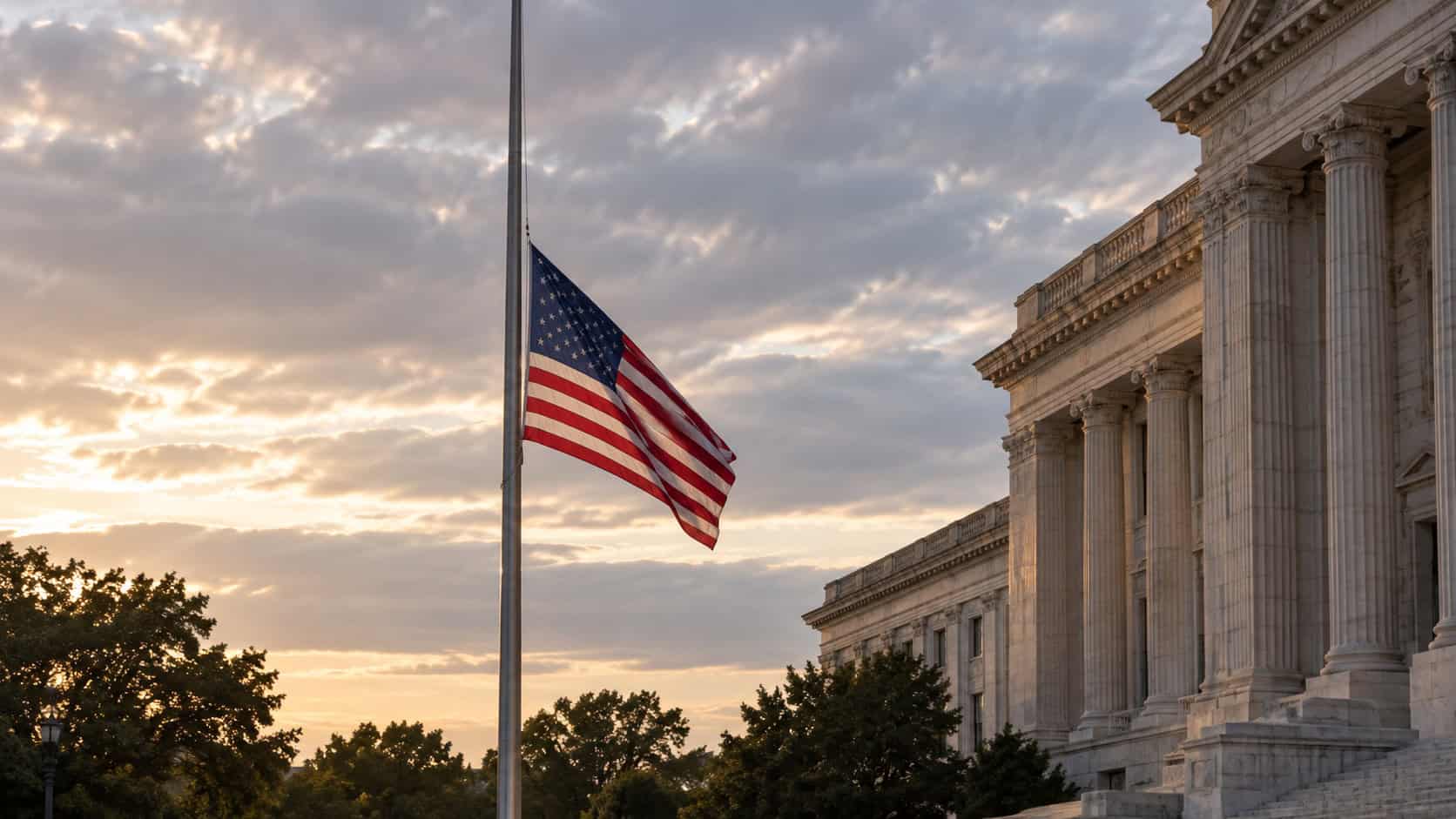
Half-staff flag rules by state are more complicated than a simple question of whether a governor has issued an order. A directive can apply to state buildings but not private property, to a county but not the entire state, to the state flag but not the United States flag, or to a specific group of public facilities. Federal installations follow their own rules, with one important statutory exception for certain gubernatorial proclamations involving members of the Armed Forces.
That is why a live “flag status” notice only answers part of the question. The more useful questions are: Who issued the directive? Which flag is covered? Which property is covered? Is participation mandatory, requested, or simply encouraged? Where is the official government source?
This America 2 Wear reference organizes those questions across all 50 states. It is designed as an authority-and-source directory, not a replacement for a governor’s office, state agency, or federal proclamation. For broader background on the flag itself, see our guides to Flag Day, the American flag folding tradition, and the reverse American flag on uniforms.
Last verified: September 17, 2026. Because flag orders can change without much notice, use the official state links below to confirm any current directive before acting on this reference.
Quick Answer: Who Can Order Flags to Half-Staff?
Federal level: The President directs the United States flag to half-staff in circumstances recognized by federal law and presidential proclamation. Federal department and agency heads also have authority over property under their jurisdiction in certain circumstances under Presidential Proclamation 3044.
State level: Under 4 U.S.C. § 7(m), a governor may proclaim the United States flag at half-staff after the death of a present or former state official, an active-duty Armed Forces member from that state, or a first responder working in that state who dies in the line of duty. States also have their own statutes, executive policies, and property-control rules.
The key distinction: A governor’s directive does not automatically mean every federal, local, school, business, or residential flagpole in that state is legally covered. Read the scope of the actual order.
Federal Half-Staff Authority Starts With 4 U.S.C. § 7(m)
The central federal rule is 4 U.S.C. § 7(m). It defines half-staff, gives the President a central role in national mourning, establishes mourning periods for certain federal officials, and recognizes gubernatorial authority in specified circumstances.
For governors, the statute specifically addresses the death of a present or former state official, an active-duty member of the Armed Forces from that state, and a first responder working in that state who dies in the line of duty. The Mayor of the District of Columbia receives parallel authority for the District.
The law also contains a narrower federal-facility rule that is easy to miss. When a governor issues a qualifying proclamation because of the death of an Armed Forces member, the United States flag at federal installations or facilities in the covered area must follow that proclamation. The statute does not use that same federal-facility sentence for every type of gubernatorial half-staff order.
Federal Agencies Have Their Own Half-Staff Authority Too
Presidential Proclamation 3044, issued by President Dwight D. Eisenhower in 1954 and later amended, remains an important part of the federal framework. It sets rules for federal buildings, grounds, naval vessels, and certain federal officials.
Section 5 of that proclamation also allows heads of federal departments and agencies to direct the United States flag to half-staff on buildings, grounds, or naval vessels under their jurisdiction on other occasions they consider proper. That is one reason a federal facility can sometimes have a flag status that differs from nearby state or local property.
For a simpler federal overview, USAGov’s flag guide notes that the President, a state governor, or the Mayor of the District of Columbia can order flags to half-staff. The legal details, however, still depend on the governing statute, proclamation, property, and specific directive.
Why Property Scope Matters
“Statewide” can mean different things in different notices. One state may direct every state-operated facility. Another may include local public buildings. A third may lower flags only at the capitol complex, in one county, or at a particular class of facilities such as police stations.
- Federal property: Controlled by federal law, presidential direction, and federal department or agency authority, with the Armed Forces death provision in 4 U.S.C. § 7(m) creating a specific requirement to follow a qualifying governor proclamation in the covered area.
- State property: Usually the clearest area of a governor’s direct administrative control, although the exact legal basis varies by state.
- County and municipal property: May be covered by state law, delegated authority, a direct statewide order, or local control. Do not assume one rule applies nationwide.
- Public schools: Some state laws or orders reach schools; others leave school property under local control.
- Private homes, businesses, churches, and organizations: Many governors encourage voluntary participation rather than purporting to command private flagpoles.
50-State Directory: Half-Staff Flag Rules by State
The entries below identify the strongest official state source located during this review and summarize the practical scope shown by a published statute, standing protocol, status page, or recent official directive. Where a standing statewide rule was not located, the entry says so rather than treating a one-time order as permanent law.
This table is a quick-reference summary, not a live flag-status service. Authority and property scope can vary by directive. Use the linked official state source and the detailed state entry below to confirm the current rule before acting.
Alabama
Alabama publishes a detailed Governor’s Office Flag Policy. The governor states direct authority over flags at Alabama state-operated facilities. The policy distinguishes statewide state-facility orders from narrower Capitol, district, or local observances, and it expressly allows the governor to delegate authority to local officials in some circumstances involving county, municipal, or city officials.
Alaska
The Alaska Governor’s Office flag-status page separately displays the status of the United States flag and Alaska flag, publishes the reason and period for a lowering, and offers a flag-status notification sign-up. Check the specific notice for the property scope of an individual order.
Arizona
Arizona maintains a dedicated Half Staff Notifications page with current status, archived notices, and notification sign-up. Recent directives identify state buildings as the required government scope while stating that individuals, businesses, and other organizations are encouraged to participate.
Arkansas
Arkansas publishes gubernatorial half-staff proclamations through the Governor’s newsroom. The wording can vary by event. Some proclamations direct both the United States and Arkansas flags to half-staff throughout the state, while others may define a narrower period or purpose. Verify the text of the current proclamation rather than assuming every Arkansas order has identical scope.
California
California publishes half-staff orders through the Governor’s official website and related proclamations. The scope can be broad, such as all state buildings, or narrow, such as the State Capitol, selected state facilities, or a particular department. California is a good example of why the property language in the specific order matters.
Colorado
Colorado publishes flag directives in the Governor’s press-release archive. Orders may be statewide or tied to the person or event being honored. No separate statewide legal matrix was located during this review, so the safest practice is to read the current governor notice for the covered flags, locations, and dates.
Connecticut
Connecticut Governor’s Office notices commonly direct United States and state flags on Connecticut state government buildings. The governor’s press releases also direct readers to sign up for news updates to receive notices when flags are ordered to half-staff.
Delaware
Delaware maintains a dedicated Governor’s Flag Status page, links to the current notice, and provides an email subscription route. Recent orders typically refer to the United States and Delaware flags at state buildings and facilities, although individual legislation can create additional observances.
Florida
Florida’s Flag Information page is one of the more complete official state resources. It includes current memoranda, an official flag protocol, alert subscription, an archive, and a process for requesting a half-staff honor. Individual Florida directives can cover state and local government buildings, installations, and grounds, so read the memorandum itself for scope.
Georgia
Georgia issues half-staff directives by executive order and preserves them in the Governor’s executive-order archive. Orders commonly specify the United States and Georgia flags on state buildings and grounds, but some honors can be geographically or institutionally narrower.
Hawaii
The Hawaii Governor’s Office maintains a dedicated Flag Orders archive. Recent statewide orders have covered the State Capitol, state offices and agencies, and Hawaii National Guard facilities. The archive makes it easier to distinguish current orders from historical ones.
Idaho
Idaho publishes gubernatorial flag directives through the Governor’s Office. Notices identify whether United States and Idaho flags are affected and the duration of the order. Idaho’s current governor site also surfaces recent half-staff directives on the homepage, making it the best official starting point located in this review.
Illinois
Illinois is unusually explicit because the state has a Flag Display Act. The official Flag Honors page says the governor orders persons or entities covered by that Act to lower the United States and Illinois flags for specified line-of-duty deaths and other honors. Illinois also offers Flag Honor alerts through the state notification system.
Indiana
Indiana publishes current directives through the Governor’s newsroom. Recent orders show that the governor can use geographically targeted language, such as a county or legislative district, and may separately encourage residents, businesses, and organizations in that area to participate.
Iowa
Iowa governor directives commonly cover the State Capitol, Capitol Complex, and all public buildings, grounds, and facilities throughout the state. They often separately encourage individuals, businesses, schools, municipalities, counties, and other government subdivisions to participate. Current notices are published by the Governor’s Office.
Kansas
Kansas uses a standing executive framework and publishes current notices through Kansas Flag Honors. Recent notices cite Executive Order 20-30 and provide a route to receive email alerts when the governor orders flags to half-staff.
Kentucky
Kentucky maintains a dedicated Flag Status page. It explains basic half-staff protocol and summarizes presidential and gubernatorial authority. Use the current notice on that page to determine which flags and properties are covered at any given time.
Louisiana
Louisiana’s Flag Status page cites state statutes governing display of the United States and Louisiana flags at the Capitol and public departments and institutions, links the governor’s current flag policy, and offers email subscription. Half-staff orders are also issued as executive orders and may specify the Capitol, all state buildings, or other defined locations.
Maine
Maine has a clear statutory rule. Title 1, §252-A says the United States and Maine flags may be flown at half-staff only at times specified by the President or governor, and it allows the governor to authorize half-staff display throughout a political subdivision or specified location. The Department of Defense, Veterans and Emergency Management also publishes current flag status.
Maryland
Maryland illustrates why the two flags must be tracked separately. Governor’s Office directives can lower both the United States and Maryland flags, while some honors lower only the Maryland flag. Official notices are published in the Governor’s press-release archive. Always check which flag is named and whether the scope is state facilities, a defined geographic area, or another class of property.
Massachusetts
The Massachusetts Flag Status page says half-staff orders are issued by the governor under 4 U.S.C. § 7(m) and Massachusetts General Laws chapter 2, § 6A. The Bureau of the State House notifies state-managed facilities by email and publishes instructions for joining that notification list.
Michigan
Michigan’s standing Executive Order 2013-10 defines “throughout the state” for the order as all state buildings, grounds, and facilities. It gives state agencies uniform direction while also providing guidance to the public. Current flag honors are published through the governor’s site.
Minnesota
Minnesota’s official Flag Status Notifications page says the governor may order the national flag to half-staff on state property only, and state law requires the Minnesota flag on state property to be lowered when the national flag is lowered there. The page also offers email notification sign-up.
Mississippi
The Mississippi governor maintains a dedicated Flag Status page with current status and executive-order history. Individual orders identify the United States and Mississippi flags, the dates involved, and the covered buildings and grounds.
Missouri
Missouri orders are often highly specific. Recent gubernatorial directives have covered government buildings in named counties or cities plus particular classes of facilities such as police stations, sheriffs’ offices, firehouses, or Missouri State Highway Patrol locations. Use the Governor’s press-release archive to confirm the exact geographic and property scope.
Montana
The Montana Governor’s Office publishes an official flag-status indicator. Because that status display contains little explanatory text, use the governor’s accompanying directive or news release when available to determine which flag, facilities, and dates are covered.
Nebraska
Nebraska publishes a detailed Governor’s Office Flag Policy. It states that the governor has authority over flags at Nebraska state-operated facilities and distinguishes statewide state-facility honors from Capitol, district, or localized observances.
Nevada
Nevada half-staff orders are published through the Governor’s Office and official press releases. The directives identify whether the United States flag, Nevada flag, or both are affected and specify the applicable period. Verify each order for whether it is statewide or tied to particular state facilities.
New Hampshire
New Hampshire codifies a state flag code in RSA 3-E:2. In addition to adopting the federal Flag Code, it requires the governor to order the flag to half-staff for a New Hampshire resident who dies in combat and requires a standing order for a fallen service member present on a military reservation within the state.
New Jersey
New Jersey’s Department of State Flag Status page is among the strongest official systems. State law requires the Secretary of State to maintain an electronic notification system, and the page also lists half-staff observances scheduled by statute. Gubernatorial executive orders identify the departments, offices, agencies, instrumentalities, and public buildings covered by each directive.
New Mexico
New Mexico publishes half-staff executive orders and releases through the Governor’s newsroom. Orders can use broad statewide language, so users should read the executed executive order linked from the official release to determine the exact scope and duration.
New York
New York’s Office of General Services flag policy is especially useful because it explains control of property. OGS manages flags at facilities under its jurisdiction, while flags at individual schools, counties, towns, organizations, and municipalities are under the supervision and control of those local entities. That makes New York a clear example of why a state notice should not automatically be treated as a command to every local flagpole.
North Carolina
The North Carolina Department of Administration flag guide draws a direct distinction between presidential proclamations, which affect federal buildings, grounds, and naval vessels, and governor’s orders, which affect state facilities. The state also maintains a dedicated flag-alert archive and email sign-up.
North Dakota
North Dakota publishes official Governor’s flag directives through the state news system. Recent orders direct government agencies to lower the United States and North Dakota flags while separately encouraging residents to do the same at homes and businesses. The news archive identifies “Flag Directives” as a category.
Ohio
Ohio combines federal practice, governor directives, and state-specific statutes. Ohio Revised Code § 5.012 governs display of the state flag, while other Ohio statutes mandate half-staff treatment for certain state observances. Gubernatorial orders can also be geographically targeted, including county government property, with other public buildings sometimes permitted to participate at their discretion.
Oklahoma
Oklahoma maintains an official Governor’s Flag Status page. Recent executive orders direct the United States, Oklahoma, and other state-designated flags on state property, with the Division of Capital Assets Management implementing the directive across appropriate state agencies.
Oregon
Oregon publishes governor flag orders through the Oregon Newsroom. Recent orders use the term Oregon public institutions and specify start and end times. Read the specific order for whether the direction is tied to federal action or a separate state honor.
Pennsylvania
Pennsylvania’s Department of General Services maintains a dedicated Flag Notices page with current United States and Commonwealth flag status. Governor orders commonly cover Commonwealth facilities, public buildings, and grounds, while residents are separately invited to participate. Pennsylvania also makes flag notifications available through its state alert system.
Rhode Island
The Rhode Island Governor’s Office displays current United States and Rhode Island flag status and offers sign-up for flag-status updates. Some gubernatorial honors apply only to the Rhode Island state flag at state facilities and buildings, with residents asked to join voluntarily.
South Carolina
South Carolina maintains a dedicated Flag Status page with email notifications. Orders can distinguish the State Capitol from other state buildings and political subdivisions. South Carolina law also mandates half-staff display at state and local public buildings for certain observances, including POW/MIA Recognition Day.
South Dakota
South Dakota’s published Flags at Half-Staff policy says flags are lowered only at the direction of the President or governor and describes the administrative notification process. Actual governor orders can be statewide or limited to the State Capitol, so the current state news release should be checked for geographic scope.
Tennessee
Tennessee maintains an official Flag Status page showing the current status. Because that page provides limited standing legal detail, consult the governor’s current order or state announcement when status changes to determine the flags, facilities, and duration involved.
Texas
The Texas Governor’s Flag Status page cites Texas Government Code Chapter 3100 and explains both current status and display rules. State agencies are governed by state directives, while individuals, businesses, municipalities, counties, and political subdivisions are encouraged to participate in half-staff observances.
Utah
Utah maintains a detailed Flag Status archive. Governor orders commonly direct the United States and Utah flags at all state facilities and separately invite private citizens, businesses, schools, counties, municipalities, and other organizations to join.
Vermont
Vermont governor directives are published through the Governor’s Office. Published orders can direct the United States and Vermont flags at the State House and state facilities while separately requesting that Vermonters, municipalities, courthouses, places of worship, or others join the observance.
Virginia
Virginia has a strong official Flag Information resource. The Office of Constituent Services issues formal governor directives for both national and state flags, provides current status, offers email alerts, links a protocol guide, and maintains a flag-order archive. Individual orders can expressly reach state and local buildings and grounds.
Washington
Washington’s Flag Lowering and Display page lists standing occasions when the governor directs the United States and Washington flags to half-staff and offers email notification sign-up. Governor directives apply to state agency facilities, while other government entities, residents, and businesses are encouraged to join.
West Virginia
The West Virginia Governor’s Office displays current flag status on its homepage. Recent orders have directed the United States and West Virginia flags at the State Capitol Complex and all state-owned facilities, with the exact dates and scope stated in the governor’s proclamation.
Wisconsin
Wisconsin issues gubernatorial half-staff directives by executive order and distributes them through the official state notification system. For example, the Governor’s Memorial Day 2026 bulletin identifies the affected United States and Wisconsin flags and the applicable period. Verify the current executive order for scope because individual observances can differ.
Wyoming
Wyoming is one of the clearest examples of why the national and state flags must be tracked separately. Official governor notices can lower both flags statewide, lower only the Wyoming state flag statewide, or lower only the Wyoming flag at the Capitol and in a named county. Current directives are distributed through the Governor of Wyoming’s official notification system.
What About the District of Columbia?
The District of Columbia is not a state, but federal law gives the Mayor of the District of Columbia authority parallel to a governor for the deaths identified in 4 U.S.C. § 7(m): present or former District officials, members of the Armed Forces from the District, and first responders working in the District who die in the line of duty.
The Federal-Installation Exception Most People Miss
A governor’s half-staff order does not generally convert every federal flagpole in that state into state-controlled property. Federal buildings remain under federal authority.
There is, however, a specific statutory exception. If a governor issues a proclamation under 4 U.S.C. § 7(m) because of the death of a member of the Armed Forces, the United States flag flown at a federal installation or facility in the area covered by that proclamation shall be flown at half-staff consistently with the proclamation.
That sentence is narrower than many summaries imply. It is tied specifically to the qualifying Armed Forces death proclamation described in the statute.
The safest question is not simply “Is the flag at half-staff?” It is “Whose flagpole is this, which flag is displayed, and what official directive governs it?”
How to Read a Half-Staff Order Correctly
Whether you manage a public building, school, business, church, veterans organization, or private property, six details usually determine what the notice means for your flagpole:
- Issuer: President, governor, federal agency head, state agency, or local authority.
- Flag: United States flag, state flag, or both.
- Property: Federal, state, county, municipal, school, agency-specific, or private.
- Geography: Nationwide, statewide, county, district, city, capitol complex, or individual facility.
- Time: Exact start and end, including whether an order begins immediately, at sunrise, at a specific hour, through interment, or until sunset.
- Instruction level: Ordered, directed, required by statute, requested, invited, or encouraged.
Those words matter. Michigan, Minnesota, New York, North Carolina, Pennsylvania, Utah, Washington, and other states expressly distinguish government property that is directed to comply from residents and organizations that are invited or encouraged to participate.
Methodology and Source Standard
This resource was researched as a primary-source directory rather than a live status service. America 2 Wear reviewed official state statutes, governor policies, executive-order archives, state flag-status pages, government press releases, and official alert systems. Federal rules were checked against the Office of the Law Revision Counsel and National Archives.
- Primary sources first: Government statutes, executive orders, policies, and official status systems were preferred over commercial flag-alert services.
- No inferred statewide mandate: If an official source said only “state buildings,” the directory does not expand that language to schools, municipalities, businesses, or private homes.
- No assumed legal basis: If a standing state statute or policy was not located, the entry describes the official order source rather than inventing a statutory citation.
- Current status is not reproduced: Status can change quickly. Readers are directed to the state’s official source for the latest order.
- Separate the United States and state flags: Some states can and do issue state-flag-only directives.
This is an editorial reference, not legal advice. Agencies, local governments, schools, and organizations with compliance responsibilities should confirm the current directive and any controlling state or local law.
Change Log
- September 17, 2026: Initial publication research completed. Federal framework and all 50 state entries reviewed against official government sources available at the time of research.
America 2 Wear intends this page to remain a maintained reference. Material changes to a state statute, standing governor protocol, official alert system, or property-scope rule should be reflected in future revisions with an updated verification date.
Frequently Asked Questions About Half-Staff Flag Authority
Can a governor order the United States flag to half-staff?
Yes, in the circumstances recognized by federal law. Under 4 U.S.C. § 7(m), a governor may proclaim the national flag at half-staff after the death of a present or former state official, an active-duty member of the Armed Forces from that state, or a first responder working in that state who dies in the line of duty. States also use their own laws, protocols, and control over state property when issuing flag directives.
Does a governor’s half-staff order apply to private homes and businesses?
Not automatically. Many state orders directly govern state-owned or state-operated property and then invite or encourage residents, businesses, schools, local governments, or other organizations to participate. The exact scope depends on the state and the wording of the order, which is why this directory links to official sources.
Do federal buildings have to follow a governor’s half-staff order?
Federal law contains a specific rule for one important situation. When a governor issues a qualifying proclamation because of the death of an Armed Forces member, 4 U.S.C. § 7(m) says the United States flag at federal installations or facilities in the covered area shall be flown at half-staff consistently with that proclamation. Other gubernatorial orders do not automatically create the same federal-facility requirement under that sentence.
Can a mayor order the United States flag to half-staff?
The federal Flag Code gives the Mayor of the District of Columbia authority parallel to a state governor for the circumstances listed in 4 U.S.C. § 7(m). Ordinary city and county officials are not given that same federal authority by the Flag Code. However, state or local law may give local officials control over flags on locally owned property, so local-government practice must be checked separately.
Can a state lower only its state flag while leaving the United States flag at full-staff?
Yes, depending on state law and policy. Some governors issue directives affecting only the state flag for particular honors. Wyoming and Maryland provide examples of state-specific directives in which the state flag can be treated differently from the United States flag. The United States flag must still be displayed consistently with federal law and any applicable federal directive.
Where should I check whether flags are at half-staff today?
Use the official source for your state whenever possible. Many states maintain a dedicated flag-status page, email alert list, governor’s flag-order archive, or agency notification page. This resource links to the official source located for each state, but current directives should always be confirmed on the government page because status can change quickly.
Why can two flagpoles in the same state show different half-staff status?
Because the two flagpoles may be governed by different authorities. A federal facility, state agency, county building, public school, municipal property, private business, and private residence can fall under different rules or policies. Some orders are statewide, while others are limited to a county, district, capitol complex, state agency, or specific class of facilities.