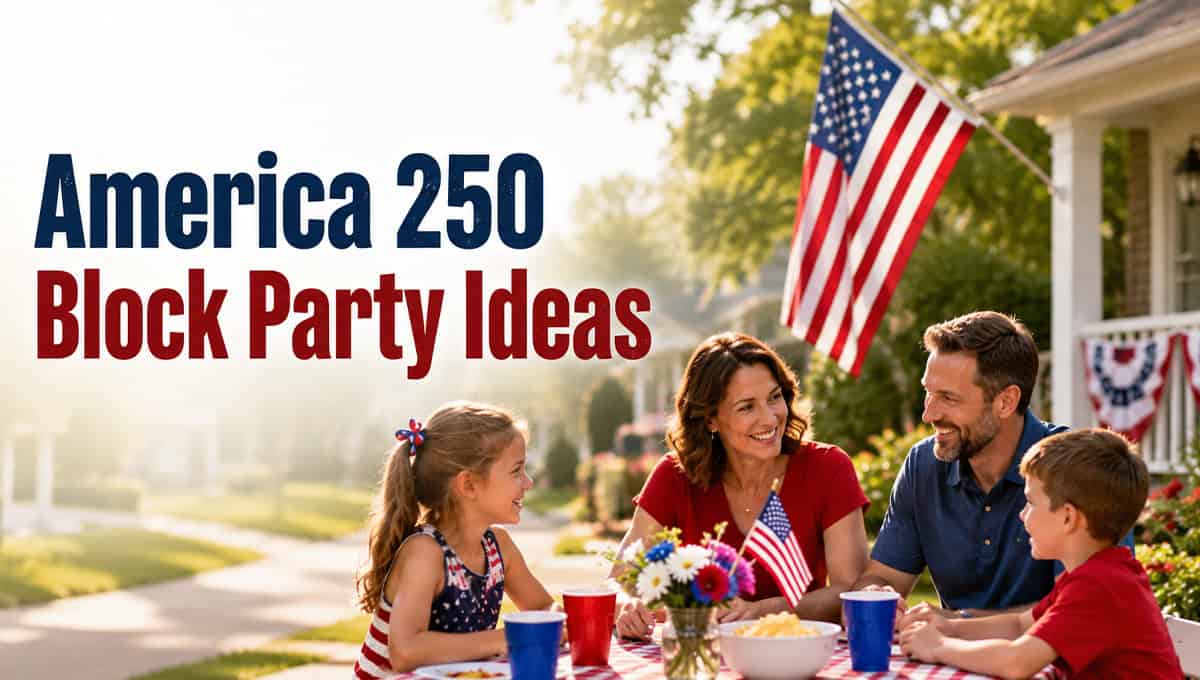
The best Fourth of July block party ideas do more than fill a street with food, music, and red, white, and blue decorations.
They bring people together.
That matters more than ever in 2026. On July 4, the United States celebrates its 250th birthday—a once-in-a-generation milestone marking two and a half centuries since the Declaration of Independence was adopted in 1776.
America’s 250th birthday does not belong only to Washington, major corporations, politicians, or nationally televised events. It belongs to the American people. It belongs to families gathering in backyards, veterans standing beneath the flag, children watching fireworks, and neighbors choosing to meet one another instead of remaining divided by fences, screens, and political labels.
An America 250 block party is a chance to celebrate freedom where the real strength of this country has always lived: inside its communities.
America 250 Block Party: Quick Planning Guide
Date: July 3 or July 4, 2026
Location: A neighborhood street, driveway, backyard, cul-de-sac, park, church, community center, or local business district
Main ingredients: Neighbors, shared food, family activities, American history, community service, music, and a respectful celebration of the flag
The goal: Give people a reason to put division aside, meet face-to-face, and celebrate the country they share.
Why an America 250 Block Party Matters
America enters its 250th anniversary after years of loud political division. Americans are constantly told what separates us, who we should fear, and why the person across the street must be our enemy.
That is not how a strong country survives.
A country endures when its people still know how to gather, cooperate, help one another, disagree without hatred, and remember that no political party owns the American flag.
A neighborhood block party may seem like a small gesture. It is not.
When neighbors share a meal, children play together, families learn a little history, and an entire street stands beneath the same flag, something important happens. America stops being an argument on television and becomes a living community again.
Before planning your celebration, read our guide explaining why America turns 250 in 2026 and what this historic anniversary represents.
15 Fourth of July Block Party Ideas for America 250
1. Choose the Right Kind of Block Party
You do not need to shut down an entire street or organize a festival for hundreds of people. Start with the kind of celebration your neighborhood can realistically support.
Your gathering might be:
- A traditional street block party
- A shared backyard cookout
- A cul-de-sac gathering
- A driveway potluck involving several homes
- A neighborhood picnic at a local park
- A church, veterans’ organization, or community-center event
- A small gathering among several families
If you plan to close a public street, use a public park, install tents, hire vendors, or bring in amplified music, contact your municipality early. Permit requirements, insurance rules, noise limits, alcohol regulations, and street-closure procedures differ by location.
Do not let the size of the event become an excuse for doing nothing. A dozen neighbors sharing burgers and talking beneath the flag still counts. America is built block by block.
2. Register as an Official America’s Block Party Host
The national America250 initiative is encouraging Americans to organize local celebrations on July 3 and July 4.
Hosts can register their gatherings through the official America’s Block Party host page. Registered hosts may receive access to a digital toolkit that includes printable signage, activity ideas, promotional materials, and information about participating in the nationwide celebration.
You may also be able to place your gathering on the official event map so nearby families can discover it.
That does not mean your event has to become formal or complicated. It simply allows one neighborhood celebration to become part of something larger happening across the country.
3. Invite the Entire Block—Not Only Your Usual Circle
A real neighborhood event should reach beyond the people you already know.
Deliver simple invitations door to door. Post information in a neighborhood group. Ask each household to invite an older neighbor, a new family, a veteran, a first responder, or someone who may otherwise spend the holiday alone.
Include the essential details:
- Date and start time
- Location
- What food or supplies guests should bring
- Whether chairs are needed
- Children’s activities
- Parking and street-closure information
- A weather backup plan
- Contact information for the organizers
Keep the invitation welcoming and nonpolitical. This is not a campaign rally. It is a celebration of a country shared by people who will not agree on every issue.
Unity does not require uniformity. It requires enough maturity to remember that disagreement does not cancel citizenship, neighborliness, or love of country.
4. Build a Small Organizing Team
Do not make one household carry the entire event.
Divide responsibility among several neighbors:
- Food coordinator: Organizes the potluck and prevents ten people from bringing the same dish
- Activity coordinator: Plans games and children’s activities
- Setup team: Handles tables, tents, chairs, signs, and trash cans
- Safety coordinator: Watches traffic areas, weather, grills, and fireworks
- History coordinator: Plans the flag ceremony, Declaration reading, or America 250 activity
- Cleanup team: Makes sure the street or park is left better than it was found
This is not only more efficient. It creates ownership. People care more about an event when they help build it.
5. Make It an All-American Potluck
Food is one of the easiest ways to bring generations and backgrounds together.
Build the menu around familiar Fourth of July favorites:
- Burgers, hot dogs, brats, and grilled chicken
- Barbecue pulled pork or ribs
- Corn on the cob
- Potato salad, pasta salad, and coleslaw
- Baked beans
- Watermelon and fresh fruit
- Apple pie, brownies, cookies, and frozen treats
- Lemonade, iced tea, and plenty of cold water
But do not stop with the expected menu. Ask families to bring a dish connected to their American story.
America was built by people who arrived through different roads and carried family recipes with them. A Polish sausage, Southern barbecue recipe, Mexican-American dessert, Italian pasta dish, Native recipe, or family pie passed down for generations can all belong on the same table.
Place a small card beside each dish explaining who brought it and why it matters to that family. Suddenly, the buffet becomes a story about America itself.
6. Protect Guests From Heat and Foodborne Illness
July can be brutally hot. A successful host plans for comfort and safety instead of hoping the weather cooperates.
Provide:
- A shaded seating area
- A clearly marked water station
- Coolers stocked with ice
- Sunscreen and insect repellent
- Indoor or air-conditioned access for older guests when possible
- A severe-weather backup plan
- A basic first-aid kit
Food safety matters as well. The USDA recommends keeping cold food at or below 40°F and hot food at or above 140°F. Perishable food should not remain unrefrigerated for more than two hours—or more than one hour when the outdoor temperature exceeds 90°F.
Keep raw meat separated from cooked food, use clean utensils and plates, and check meat with a food thermometer instead of judging doneness only by appearance. Review the USDA’s summer cookout food-safety guidance before the event.
7. Display the American Flag With Respect
The American flag should be the center of the celebration—not another disposable decoration.
Display a real flag from a pole, building mount, or secure stand. Keep it from touching the ground, pavement, water, or nearby tables. If the flag remains displayed after dark, it should be properly illuminated.
If several flags are displayed together, the American flag should occupy the position of honor. When using decorative material on tables, fences, stages, or railings, use patriotic bunting rather than draping an actual American flag over those surfaces.
The Department of Veterans Affairs provides a helpful overview of proper American flag display.
You can also learn more about the flag’s history in our article, What Is Flag Day and Why Does It Still Matter?
Patriotism is not measured by how many flags we hang. It is demonstrated by whether we understand what the flag represents and treat it accordingly.
8. Read Part of the Declaration of Independence
America’s 250th birthday should include at least one moment that reminds people what is actually being celebrated.
You do not have to read the entire Declaration aloud. Select a short passage from the opening and ask a veteran, teacher, student, first responder, or longtime resident to read it before dinner.
Then ask one simple question:
What does freedom require from us today?
Give children and adults an opportunity to answer. The discussion does not need to become political. Focus on responsibility, courage, service, respect for rights, self-government, and the obligation to leave the country stronger for the next generation.
The complete text is available through the National Archives’ Declaration of Independence transcript.
9. Recognize Veterans, Active-Duty Service Members, and First Responders
Freedom was declared in 1776, but it had to be defended before it could survive.
Take a few minutes to recognize veterans, current service members, police officers, firefighters, paramedics, dispatchers, and others who protect the community.
This does not need to become a long ceremony. Ask them to stand, announce their names if they are comfortable, and offer a sincere round of applause.
You can also create a neighborhood honor board containing photographs and names of residents or family members who served.
Do not reduce sacrifice to a marketing slogan. Look people in the eye. Learn their names. Hear their stories. Let children understand that freedom has always required real people to accept real responsibility.
10. Plan Children’s Activities That Teach Something
Children will remember the games and fireworks, but America’s 250th birthday is also a chance to place a little history in their hands.
Try activities such as:
- A 13-colonies scavenger hunt
- A Declaration of Independence word search
- A “What America Means to Me” drawing table
- A patriotic sidewalk-chalk mural
- A founding-document trivia game
- A state flag matching challenge
- A children’s costume parade featuring people from American history
- A station where children write a letter to America’s future
Keep the activities age-appropriate and honest. American history contains courage, achievement, conflict, failure, sacrifice, and progress. Children do not need a shallow fairy tale, but they do need to know they inherited a country worth understanding and improving.
11. Bring Back Classic Neighborhood Games
Not every activity needs a screen, app, or expensive rental.
Set up games that children, parents, and grandparents can enjoy together:
- Cornhole
- Three-legged races
- Sack races
- Water-balloon tosses
- Wiffle ball
- Horseshoes
- Sidewalk chalk contests
- Pie-eating contests
- Patriotic trivia
- Best-decorated bicycle parade
Create mixed-age teams instead of dividing every activity by household. The purpose is not only to identify a winner. It is to get people laughing and working together.
12. Build a Soundtrack That Feels Like America
Music can carry the event from the afternoon meal into the evening celebration.
Create a playlist that includes several generations and regions of American music—country, rock, blues, soul, folk, jazz, Motown, bluegrass, and patriotic standards.
Ask neighbors to submit one song that represents America to them. The final playlist may be imperfect, unexpected, and wide-ranging.
Good. So is America.
Keep the volume reasonable, especially near older residents, young children, veterans who may be sensitive to sudden noise, and neighbors who are not attending. Celebrating freedom does not require ignoring courtesy.
13. Create a Neighborhood Story Wall or Time Capsule
America’s history is not made only of presidents, generals, and famous speeches. It is built from millions of family stories.
Set up a board where guests can complete prompts such as:
- “My family’s American story began when…”
- “The freedom I value most is…”
- “My hope for America’s next 50 years is…”
- “A person who taught me to love this country was…”
- “One thing our neighborhood can do better is…”
You can also create a neighborhood time capsule containing photographs, children’s drawings, letters, local newspaper pages, family stories, and a guest list from the celebration.
Choose a future date—perhaps July 4, 2051, when America turns 275—to reopen it.
The exercise turns one summer afternoon into a record of what your community believed, valued, and hoped to build.
14. Add a Giving 4th Community Project
A strong country is not built by celebration alone. It is built by citizens willing to serve.
America250 is encouraging Americans to add charitable giving and community service to their July 4 traditions. Your block party can support that goal in a direct, local way.
Choose one project:
- Collect food for a local pantry
- Gather school supplies for children
- Accept donations for a veterans’ organization
- Collect pet supplies for an animal shelter
- Organize a neighborhood cleanup before the party
- Raise funds for a local family facing hardship
- Write thank-you cards to deployed service members or first responders
- Check on older neighbors and help with basic outdoor work
Keep the project transparent. Clearly identify the organization, explain what is being collected, and tell guests where the donations will go.
A country is renewed when its people stop asking who should fix everything and begin doing what they can with what they have.
15. Dress for the Milestone—and End the Night Safely
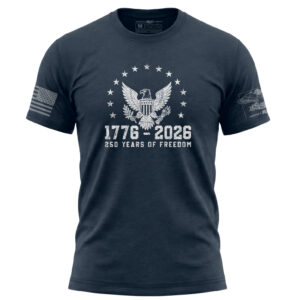
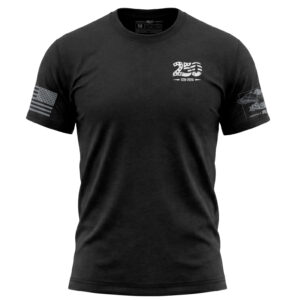
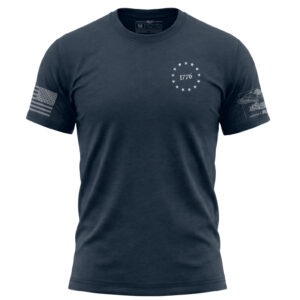
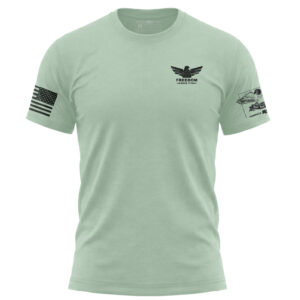
Encourage guests to wear red, white, blue, American flag apparel, 1776 designs, or clothing representing a branch of service, state, hometown, or family heritage.
Set up a simple America 250 photo area with a flag, hay bales, wooden crates, patriotic bunting, or a sign showing “1776–2026.” Take a full-neighborhood photograph before daylight fades.
For outfit ideas, read our guide to what to wear for America’s 250th birthday or explore our recommendations for patriotic summer barbecue and July 4 outfits.
If fireworks are part of the evening, first check state and local laws. A professional community show is generally the safest choice.
The Consumer Product Safety Commission advises adults never to allow young children to handle fireworks, including sparklers. Keep water or a garden hose nearby, light only one device at a time, never attempt to relight a malfunctioning firework, and never use fireworks while impaired by alcohol or drugs.
Review the complete CPSC fireworks safety recommendations before allowing consumer fireworks at a gathering.
End the evening by thanking the volunteers, recognizing the neighbors who attended, and reminding everyone why they gathered.
Not because America is perfect.
Not because Americans agree on everything.
But because this country still belongs to its people—and its future depends on whether those people can stand together.
Sample America 250 Block Party Schedule
Every gathering will be different, but this timeline gives you a practical starting point:
- 3:00 p.m.: Setup begins
- 4:00 p.m.: Guests arrive and food tables open
- 4:30 p.m.: Children’s activities and neighborhood games
- 5:30 p.m.: Main meal
- 6:30 p.m.: Declaration reading and brief America 250 message
- 6:45 p.m.: Recognition of veterans, service members, and first responders
- 7:00 p.m.: Music, games, dessert, and community story wall
- 8:00 p.m.: Neighborhood America 250 photograph
- 8:15 p.m.: Giving 4th announcement and collection total
- After dark: Attend a professional fireworks display or begin a legal, adult-supervised fireworks program
America 250 Block Party Checklist
- Confirm the location
- Check permits, insurance, and local rules
- Register the gathering with America250
- Invite every household
- Create a food signup list
- Assign setup, activity, safety, and cleanup teams
- Arrange tables, chairs, shade, coolers, and lighting
- Prepare children’s games and history activities
- Display the American flag properly
- Select a Declaration passage
- Plan veteran and first-responder recognition
- Choose a community-service project
- Create a weather backup plan
- Provide trash and recycling containers
- Take a neighborhood photograph
America Belongs to the People
Politicians will speak about America’s 250th birthday. Corporations will advertise around it. Television networks will broadcast it.
But they do not own it.
America belongs to the people who wake up, go to work, raise families, build businesses, serve their communities, defend their neighbors, and refuse to let manufactured division destroy the country they share.
This July 4, open the driveway. Set up the tables. Fly the flag correctly. Invite the neighbor whose name you still do not know. Feed people. Hear their stories. Teach the children. Honor those who served. Help someone who needs it.
That is how a nation celebrates 250 years.
Not as strangers shouting across a divide.
As Americans standing together.
Wear the Milestone. Carry the Meaning.
America turns 250 only once. Mark the anniversary with patriotic apparel created for Americans who still believe freedom is worth standing for.
Frequently Asked Questions About America 250 Block Parties
What is an America 250 block party?
An America 250 block party is a neighborhood, family, community, or local organization gathering celebrating the United States’ 250th anniversary. It can include food, music, games, American history, volunteer service, and other Fourth of July activities.
When should an America 250 block party be held?
Most America 250 block parties will be held on July 3 or July 4, 2026. A neighborhood may choose another nearby date when local schedules, weather, permits, or community events make that more practical.
Does an America 250 celebration have to be a large event?
No. An America 250 celebration can be a large public festival, a traditional neighborhood block party, a backyard cookout, or a small gathering among several families. The purpose is to bring people together and recognize the historic anniversary.
Do I need a permit for a Fourth of July block party?
You may need a permit if the event closes a public street, uses public property, includes vendors, serves alcohol, installs large tents, or features amplified music. Contact your municipality or park district because requirements differ by location.
How can I make a Fourth of July block party meaningful?
Read part of the Declaration of Independence, recognize veterans and first responders, collect family stories, organize a community-service project, teach children about American history, and create time for neighbors to meet one another.
How should the American flag be displayed at a block party?
Keep the flag from touching the ground, pavement, water, or tables. Place it in the position of honor when displayed with other flags, illuminate it if it remains outside after dark, and use patriotic bunting rather than an actual flag as disposable decoration.
What are good foods for a Fourth of July block party?
Popular options include burgers, hot dogs, barbecue, grilled chicken, corn, baked beans, potato salad, watermelon, apple pie, cookies, lemonade, and iced tea. A potluck featuring dishes connected to each family’s American story can make the meal more meaningful.
Where can I register an official America 250 block party?
Hosts can register through the official America250 website. Registration may provide access to a digital host toolkit, printable materials, activity suggestions, and the opportunity to add the gathering to the official event map.