Why is the bald eagle America’s national bird? The answer begins long before federal law ever used that exact title. The bald eagle became the central bird on the Great Seal of the United States in 1782, and generations of Americans came to associate it with freedom, independence, strength, vigilance, and national sovereignty.
Its white head and dark wings appear on official seals, passports, currency, military imagery, public buildings, patriotic artwork, and countless parts of American culture. Like the American flag and the Liberty Bell, the bald eagle became more than an official emblem. It became part of the visual language Americans use to talk about liberty and national identity.
But there is an important twist in the story. For more than two centuries, Americans routinely called the bald eagle the national bird even though federal law had never formally given it that designation.
That changed on December 23, 2024, when Public Law 118-206 amended Title 36 of the United States Code to formally designate the bald eagle as the national bird.
So why was the bald eagle chosen in the first place, what does it mean on the Great Seal, and how did a bird once pushed dangerously close to disappearance become one of the most enduring symbols of the United States?
Quick Answer: Why Is the Bald Eagle America’s National Bird?
The bald eagle became one of America’s defining national symbols when it was placed at the center of the Great Seal of the United States in 1782. Its North American identity and long association with freedom, independence, strength, vigilance, and national sovereignty helped establish its place in American culture.
Although Americans had treated the bald eagle as the national bird for generations, federal law did not formally designate it as the national bird until December 23, 2024.
When Did the Bald Eagle Become an American Symbol?
The bald eagle’s official connection to the United States begins with the creation of the Great Seal.
Only hours after approving the Declaration of Independence on July 4, 1776, the Continental Congress appointed Benjamin Franklin, Thomas Jefferson, and John Adams to a committee charged with developing a seal for the new nation. Their proposal was not adopted.
Creating the final seal took six years and three committees. In 1782, Secretary of the Continental Congress Charles Thomson combined elements from earlier proposals into a new design. The Continental Congress approved the final design on June 20, 1782, according to the National Archives.
At its center was an American bald eagle with its wings spread.
Thomson did not simply choose an impressive-looking bird. He incorporated the eagle into a larger system of symbols meant to express the character and aspirations of the new republic.
From that point forward, the bald eagle occupied a special place in American public life. But one distinction matters: appearing on the Great Seal was not the same thing as being formally designated the national bird.
That legal distinction would take another 242 years.
Why Was the Bald Eagle Chosen?
There was no single congressional statement in 1782 declaring that the bald eagle had been chosen because it represented one particular quality. Its meaning grew from the Great Seal, the bird’s own characteristics, and the values Americans increasingly attached to it.
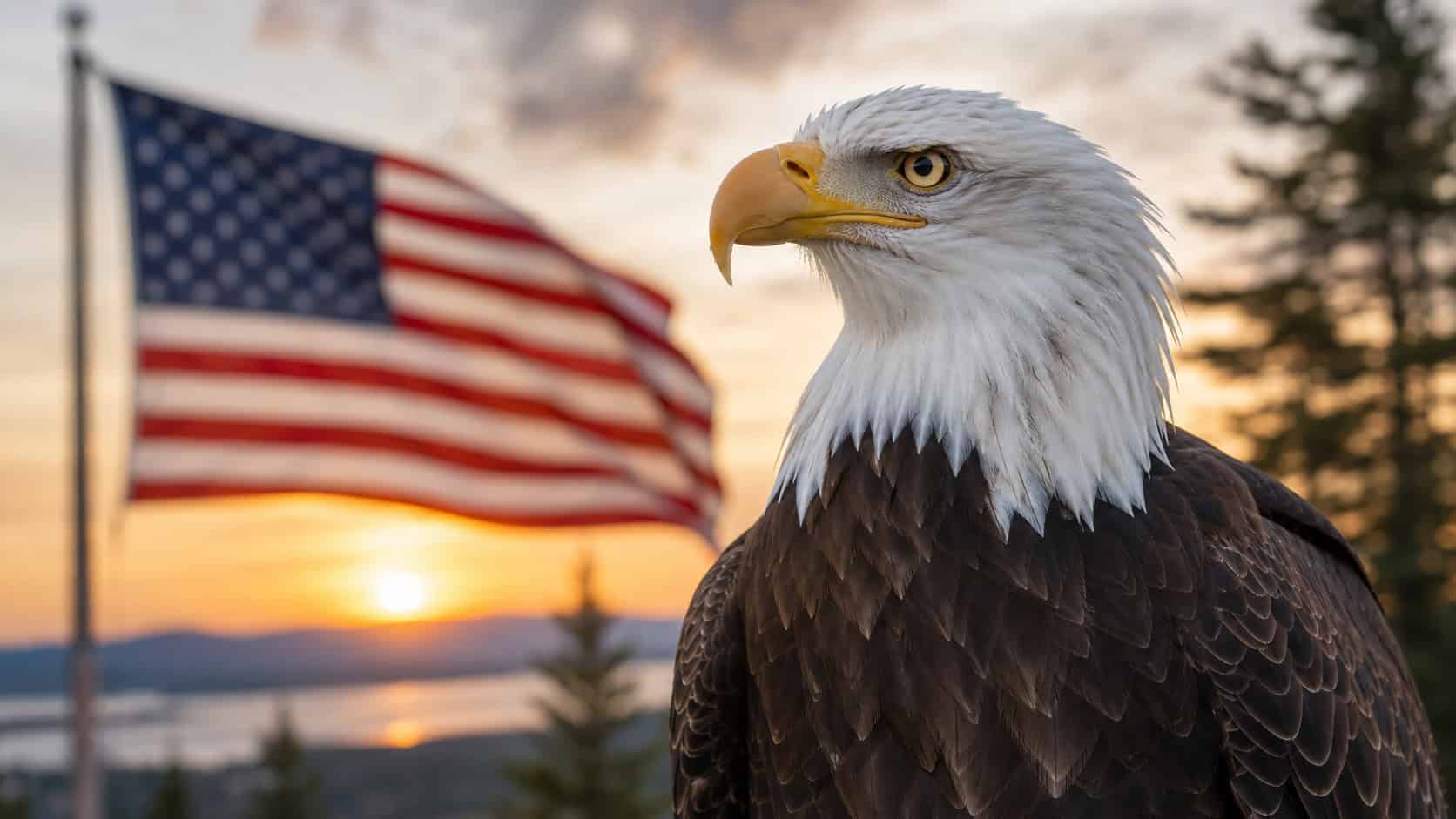
The bald eagle is native to North America, which made it especially fitting for a new nation trying to establish an identity of its own. The species is also visually distinctive. Mature bald eagles have dark brown bodies, white heads and tails, yellow beaks, and wingspans that can approach seven feet. Younger eagles do not immediately have the famous white head and tail, which develop as they mature.
The bird’s size, independence, commanding appearance, and ability to soar high above the landscape helped make it a natural emblem for a country that had fought to govern itself.
Over time, Americans associated the bald eagle with ideas including:
- freedom
- independence
- strength
- courage
- vigilance
- national sovereignty
Those meanings now sit comfortably alongside other American symbols that carry both official and cultural significance. That broader relationship between symbols, values, and everyday expression is also explored in Freedom Threads: The Meaning Behind Patriotic Apparel.
What Does the Eagle on the Great Seal Mean?
To understand why the bald eagle became such a powerful American symbol, it helps to look closely at the Great Seal itself.
The eagle is not standing alone. Nearly every element around it carries meaning.
In one talon, the eagle holds an olive branch. In the other, it holds 13 arrows. The State Department describes these as representing the power of peace and war. The eagle’s head faces toward the olive branch, reinforcing the preference for peace while retaining the ability to defend the nation.
The number 13 appears repeatedly in the design for the original states. There are 13 arrows, 13 stripes on the shield, and a constellation of 13 stars above the eagle.
In its beak, the eagle carries a scroll bearing the Latin motto E Pluribus Unum, commonly translated as “Out of Many, One.”
The eagle therefore became more than a symbol of raw strength. In the Great Seal, it sits within a design about peace and defense, union and independence, and a republic expected to rely on its own character and institutions.
Was Benjamin Franklin Against the Bald Eagle?
No history of the American eagle is complete without Benjamin Franklin and the turkey.
The popular version of the story usually says Franklin opposed the bald eagle as America’s symbol and wanted the turkey to become the national bird instead. There is some truth behind that story, but it is often exaggerated.
Franklin did criticize the bald eagle. In a 1784 private letter to his daughter, Sarah Bache, written after the Great Seal had already been adopted, he contrasted the eagle unfavorably with the turkey.
What he did not do was formally propose the turkey as a replacement national emblem during the Great Seal debates.
Franklin had served on the first Great Seal committee in 1776, but his proposed design featured neither an eagle nor a turkey. His later remarks were private commentary, not an official campaign to swap one national bird for another.
The turkey story survives because it is memorable. But saying simply that “Benjamin Franklin wanted the turkey to be America’s national bird” turns a humorous private observation into a proposal he did not actually make.
Was the Bald Eagle Always Officially the National Bird?
This is where the history becomes especially surprising.
For generations, government publications, classrooms, reference books, and ordinary Americans routinely described the bald eagle as the national bird of the United States. Culturally, there was little doubt about its status.
Legally, however, there was a gap. The eagle had served as a national symbol since 1782, but federal law did not contain a provision formally declaring the species the national bird.
Congress finally corrected that omission in 2024. Public Law 118-206 was approved on December 23, 2024 and amended Title 36 of the United States Code.
The bald eagle did not become meaningful because Congress named it in 2024. Congress put into law what Americans had already recognized for generations: this living symbol had long since earned its place.
The law itself is direct: “The bald eagle (Haliaeetus leucocephalus) is the national bird.”
In other words, the 2024 law did not create the bald eagle’s symbolic importance. It formally recognized a role the bird had already occupied in American life for more than two centuries.
The Bald Eagle Nearly Disappeared From Much of America
The eagle’s place in American history has another dimension that is easy to overlook. For all of its prominence as a national symbol, the actual bird once faced a severe decline.
Habitat loss, illegal shooting, and environmental contamination contributed to falling bald eagle numbers during the twentieth century. One of the most damaging factors was DDT, a pesticide whose residues entered waterways and the food chain and harmed eagle reproduction.
By 1963, only 417 known nesting pairs remained in the lower 48 states, according to the U.S. Fish & Wildlife Service.
Congress had already passed the Bald Eagle Protection Act in 1940. Federal protections expanded over time, and the Environmental Protection Agency banned most uses of DDT in the United States in 1972. Habitat conservation, nest protection, law enforcement, captive breeding, reintroduction, and other recovery efforts followed.
The results were remarkable.
By 2007, the Fish & Wildlife Service estimated at least 9,789 nesting pairs in the contiguous United States. The species had recovered enough to be removed from the federal list of threatened and endangered species that year.
Based on survey work from 2018 and 2019, the Service later estimated approximately 316,700 individual bald eagles, including about 71,400 nesting pairs, in the lower 48 states.
The bald eagle remains protected under federal laws even though it is no longer listed under the Endangered Species Act. Its recovery turned the nation’s emblem into something else as well: a powerful example of what sustained conservation can accomplish.
Why Is It Called a “Bald” Eagle?
Despite the name, bald eagles are not bald.
Mature birds have a conspicuous covering of white feathers on the head. The name comes from an older meaning of the word “bald” associated with being white or white-marked rather than hairless.
The scientific name, Haliaeetus leucocephalus, likewise refers to the bird’s distinctive white-headed appearance.
More Than a Government Emblem
A national symbol survives only when people continue to find meaning in it.
The bald eagle has done that for nearly two and a half centuries. It appears on the Great Seal, passports, official documents, currency, military imagery, public architecture, monuments, artwork, patches, clothing, and objects displayed in American homes.
But the eagle’s cultural reach extends well beyond government.
For many Americans, it represents an idea of freedom that carries responsibility with it. Independence does not mean isolation from one’s fellow citizens. Strength is not the same as domination. National pride does not require pretending that the country’s history is simple or flawless.
At its best, the eagle represents a country confident enough to defend its liberties while recognizing the obligations that come with preserving them.
That is also why its conservation story belongs alongside its political history. A nation can place an animal on its seal, but preserving the living species requires choices, restraint, responsibility, and stewardship across generations.
Why the Bald Eagle Still Matters
The United States has many enduring symbols. The Stars and Stripes represents the nation itself. The Liberty Bell recalls the long American argument over liberty. The Declaration of Independence articulates principles that continue to challenge every generation. The Constitution established the framework through which Americans govern themselves.
The bald eagle occupies a different place because it is alive.
It can still be seen soaring above rivers, lakes, forests, coastlines, and communities across much of the country. The same species placed at the center of the Great Seal in 1782 remains part of the American landscape today.
The bald eagle became an emblem during the nation’s founding era, survived a period when its population was pushed dangerously low, recovered through decades of conservation, and finally received formal recognition as the national bird in 2024.
Its story is larger than the question of why one bird was chosen over another. It is a story about independence and union, strength and restraint, decline and recovery, and the responsibility to preserve what earlier generations handed down.
For more than 240 years, Americans treated the bald eagle as their national bird before the law officially caught up. The paperwork came late. The symbol had already earned its place.
Wear the Eagle With Meaning
The bald eagle’s history gives the symbol weight beyond decoration. For readers who want to carry that symbolism into everyday wear, these in-stock eagle designs offer a mix suited to warm August weather, including two T-shirts and an embroidered cap.
-

Patriotic T-Shirts, American Eagle & Flag Apparel, Minimalist Patriotic Tees
Price range: $29.99 through $33.99Select options This product has multiple variants. The options may be chosen on the product page -
Patriotic T-Shirts, 1776 & Constitution Apparel, American Eagle & Flag Apparel, Minimalist Patriotic Tees
Price range: $29.99 through $33.99Select options This product has multiple variants. The options may be chosen on the product page -
American Eagle & Flag Apparel, Patriotic Baseball Hats
$29.99Select options This product has multiple variants. The options may be chosen on the product page



Frequently Asked Questions About the Bald Eagle as America’s National Bird
Why is the bald eagle America’s national bird?
The bald eagle became closely tied to the United States after it was placed at the center of the Great Seal in 1782. Its North American identity, commanding appearance, and long association with freedom, independence, strength, and sovereignty helped make it the country’s enduring bird symbol. Federal law formally designated it the national bird in 2024.
When did the bald eagle officially become the national bird?
The bald eagle was formally designated the national bird on December 23, 2024, when Public Law 118-206 amended Title 36 of the United States Code. Americans had already treated the bald eagle as the national bird for generations because of its place on the Great Seal.
When was the bald eagle added to the Great Seal?
The Continental Congress approved the final design of the Great Seal on June 20, 1782. The design created by Charles Thomson placed an American bald eagle at its center.
Did Benjamin Franklin want the turkey to be the national bird?
Not in the way the popular story suggests. Franklin criticized the bald eagle and praised the turkey in a private 1784 letter to his daughter, but he did not formally propose replacing the eagle with a turkey during the Great Seal debates.
What do the olive branch and arrows on the Great Seal mean?
The olive branch represents peace, while the arrows represent the power to wage war and defend the nation. Together they express a preference for peace backed by the ability to protect the country.
How close did bald eagles come to disappearing?
By 1963, only 417 known nesting pairs remained in the lower 48 states. Decades of legal protection, habitat conservation, restrictions on DDT, and other recovery efforts helped the population rebound dramatically.
Are bald eagles still protected by federal law?
Yes. Bald eagles were removed from the federal threatened and endangered species list in 2007 after their recovery, but they remain protected under federal laws including the Bald and Golden Eagle Protection Act and the Migratory Bird Treaty Act.