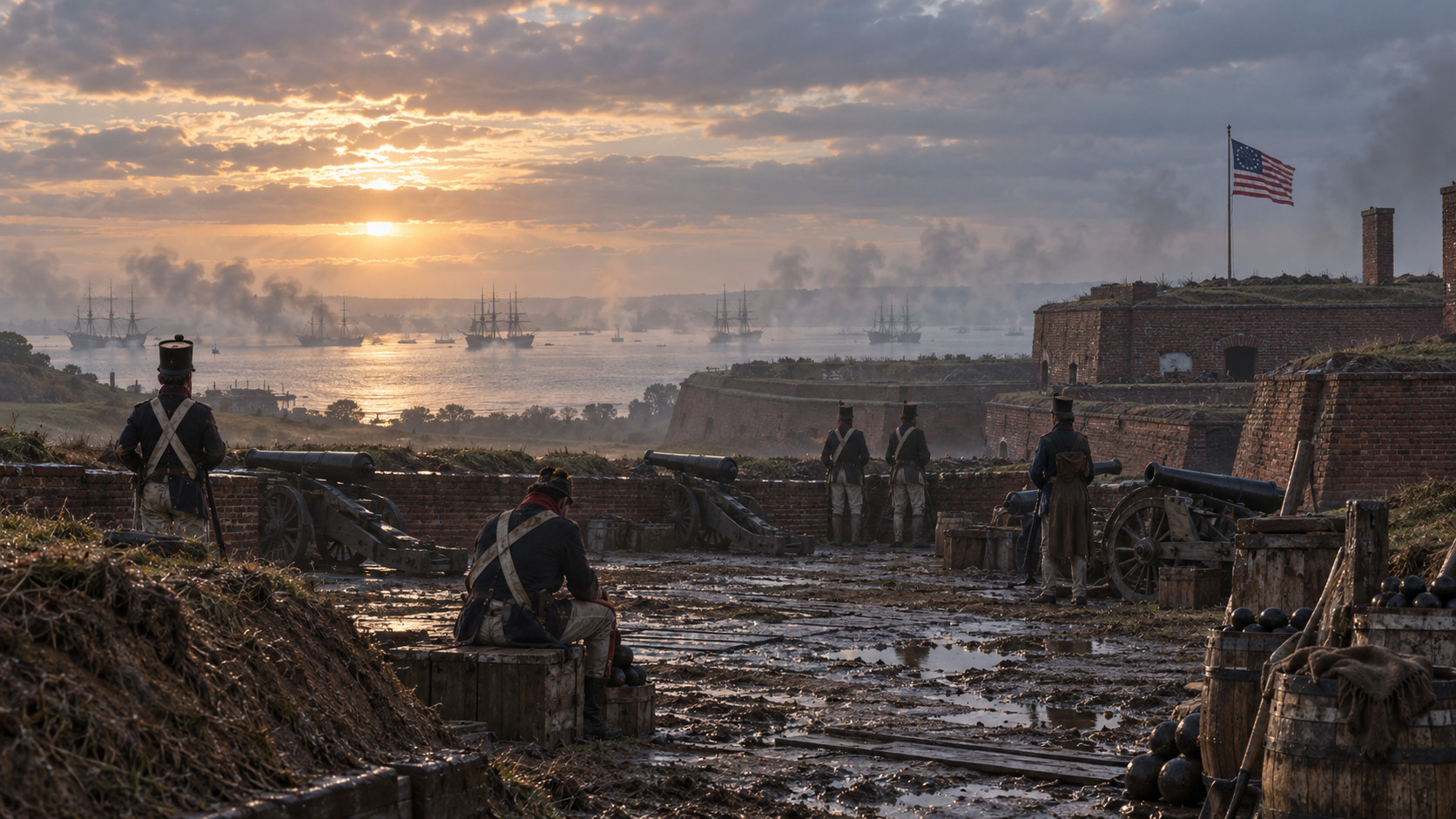
Why is “The Star-Spangled Banner” our national anthem? The answer begins more than a century before Congress made it official. It begins in Baltimore Harbor, during a long night of bombardment in the War of 1812, with an American lawyer watching to see whether a flag would still be flying when morning came.
That lawyer was Francis Scott Key. The flag he saw was not the familiar 50-star banner Americans know today. It was an enormous 15-star, 15-stripe garrison flag made specifically for Fort McHenry by Baltimore flagmaker Mary Pickersgill and a small group of young women working with her.
When Key saw that flag above the fort on the morning of September 14, 1814, he knew the British attack on Baltimore had failed. He began putting the experience into words. Those words became “The Star-Spangled Banner,” a song that spread across the country long before the federal government formally designated it as the national anthem in 1931.
The story connects a battle, a handmade flag, an already-familiar melody, and more than a century of American tradition. Understanding that history helps explain why a song born during one night at Fort McHenry became one of the most recognizable symbols of the United States.
Quick Answer: Why Is “The Star-Spangled Banner” Our National Anthem?
Francis Scott Key wrote the words that became “The Star-Spangled Banner” after witnessing the British bombardment of Fort McHenry on September 13-14, 1814. When he saw the large American flag still flying over the fort the next morning, he knew Baltimore had held.
The song became widely recognized as a national patriotic air over the following century. The Secretary of the Navy designated it as the tune to be played at the raising of the flag in 1889, and it gained additional official use during the early twentieth century.
Official designation: President Herbert Hoover signed the congressional measure making “The Star-Spangled Banner” the national anthem on March 3, 1931.
The Story Begins With a Flag, Not a Song
More than a year before Francis Scott Key wrote a single line, Major George Armistead, commander of Fort McHenry, wanted a flag large enough to be unmistakable from a distance.
In the summer of 1813, Baltimore flagmaker Mary Pickersgill received the job of making two flags for the fort: a 17-by-25-foot storm flag and a massive 30-by-42-foot garrison flag. According to the Smithsonian’s National Museum of American History, Pickersgill worked with her daughter Caroline, her nieces Eliza and Margaret Young, and Grace Wisher, a 13-year-old African American indentured servant. Pickersgill’s mother, Rebecca Young, may also have helped.
The garrison flag was so large that the workers needed the floor of a nearby brewery to assemble it. Its wool stripes were about two feet wide, and its cotton stars were roughly two feet across.
It also looked different from the modern American flag. In 1814, the official flag had 15 stars and 15 stripes, reflecting the admission of Vermont and Kentucky. Congress would later return the flag to 13 stripes while continuing to add a star for each new state. That broader evolution is part of the history behind Flag Day and the American flag.
The banner that survives today is smaller than its original dimensions because portions were removed during the nineteenth century, sometimes as keepsakes. The surviving flag is now preserved at the Smithsonian’s National Museum of American History.
Why Francis Scott Key Was Watching Fort McHenry
The circumstances that placed Francis Scott Key near the battle were unusual. Key was a Georgetown lawyer who had gone with American prisoner-exchange official John Stuart Skinner to negotiate the release of Dr. William Beanes, a Maryland physician who had been taken by the British.
The British agreed to release Beanes, but Key, Skinner, and Beanes had learned too much about the coming attack on Baltimore to be allowed to return immediately. They were held with their American truce vessel as British forces moved toward the city.
According to the National Park Service account of Francis Scott Key, the three Americans watched the approximately 25-hour bombardment of Fort McHenry as British ships fired shells and rockets at the fort.
This came only weeks after British forces had entered Washington and burned major public buildings. Baltimore was an important port, and Fort McHenry guarded the water approach to the city. If the fort fell, the consequences for Baltimore could have been severe.
What Francis Scott Key Saw at Dawn
Through the night, Key could see the flashes of the bombardment. As long as Fort McHenry continued answering the attack, there was reason to believe the American defenders were still holding their position.
When the firing finally stopped, uncertainty remained. Had the fort surrendered, or had the British given up?
The answer became visible with daylight. The American flag was still flying above Fort McHenry.
There is an important detail that often gets lost in retellings of the story. Fort McHenry had both the enormous garrison flag and a smaller storm flag. Historians believe the smaller flag may have been used during the rainy bombardment. The huge 30-by-42-foot garrison flag was raised on the morning of September 14 as the British attack failed.
That was the banner Key saw clearly at dawn. The sight told him that the fort remained in American hands.
The anthem’s central image is powerful because it is so simple: after a night when the outcome was uncertain, the flag was still there.
From “Defence of Fort M’Henry” to “The Star-Spangled Banner”
Key began writing about what he had witnessed and eventually produced four stanzas under the title “Defence of Fort M’Henry.” The words were printed and distributed in Baltimore soon after the battle.
The lyrics were paired with an existing English melody known as “To Anacreon in Heaven,” a tune associated with London’s Anacreontic Society and commonly credited to British musician John Stafford Smith. The melody was already familiar in the United States before Key used it.
That matters because the popular story that Key simply wrote a poem that somebody later decided to turn into a song is incomplete. Early printings already connected Key’s words with the familiar tune, and the song spread quickly.
The Library of Congress history of “The Star-Spangled Banner” traces how the song became increasingly identified with the American flag during the nineteenth century. Long before it had official legal status, Americans were already using it as a patriotic national air.
Why Did It Take Until 1931 to Become the National Anthem?
“The Star-Spangled Banner” did not become the national anthem immediately after the War of 1812. In fact, the United States went for generations without a single national anthem formally established by federal law.
Several patriotic songs filled that cultural space, including “Hail Columbia,” “America,” and later “America the Beautiful.” Meanwhile, “The Star-Spangled Banner” became increasingly associated with official ceremonies and the flag itself.
In 1889, the Secretary of the Navy designated it as the tune to be played at the raising of the flag. During Woodrow Wilson’s presidency, the White House also directed its use on occasions calling for a national anthem.
The choice was not without debate. Critics complained that the melody was difficult to sing, questioned its musical origins, or preferred other patriotic songs. Supporters argued that its connection to the American flag and its long use in national ceremonies had already given it a unique place in American life.
Congress ultimately acted in 1931. President Herbert Hoover signed the measure on March 3 of that year, formally designating the composition known as “The Star-Spangled Banner” as the national anthem of the United States.
In other words, Congress did not suddenly create the song’s importance in 1931. It gave legal recognition to a patriotic tradition that had developed over more than a century.
The Full History Is More Complicated Than the First Verse
Most Americans know only the first of Key’s four stanzas. The additional verses are rarely performed today, and parts of the complete text reflect the language, warfare, and political world of 1814.
The third stanza includes the phrase “hireling and slave,” a line that has generated substantial historical debate. The National Park Service notes that Key left no explanation of exactly what he meant. Interpretations have included foreign troops serving with Britain and formerly enslaved men who joined British forces.
Key’s own relationship with slavery was also complicated and consequential. He owned enslaved people, opposed abolition, and participated in the legal system that sustained slavery, even though he also represented some enslaved people seeking freedom and freed several people he held in bondage.
Those facts are part of the historical record. Treating them seriously does not require ignoring what the song became to later generations. It means recognizing that national symbols often carry histories larger and more complicated than any single moment, person, or interpretation.
Why the Flag and the Anthem Became So Closely Connected
The song does not simply mention the flag. Its entire dramatic question depends on the flag.
Could Key see it through the bombardment? Was it still flying? Had the fort survived? The repeated image of the “star-spangled banner” turned a military garrison flag into the central symbol of the song.
Over time, that relationship became part of American civic tradition. The flag appears during the anthem at military ceremonies, sporting events, public gatherings, schools, memorials, and community observances. The song and the symbol reinforce one another.
That is also why other American flag traditions carry such emotional weight. The ceremonial practice behind folding the American flag into a triangle, for example, developed separately but reflects the same tendency to treat the flag as more than an ordinary piece of cloth.
What “The Star-Spangled Banner” Represents Today
No single sentence can dictate what the national anthem must mean to every American. People encounter it through different experiences, including military service, citizenship ceremonies, school events, sporting traditions, family history, protest, remembrance, and celebration.
Its historical origin, however, is specific. A city had been attacked. A fort had endured. At dawn, an American flag still flew above the defenses.
That image proved durable enough to outlive the battle itself. The song spread, became attached to national ceremonies, and eventually received legal recognition as the anthem of the United States.
It also joined a larger group of American symbols whose meanings developed across generations. The bald eagle’s rise as an American national symbol followed a very different path, but both stories show how an image can begin in a particular historical setting and gradually acquire broader national meaning.
A Flag, a Song, and a National Memory
So why is “The Star-Spangled Banner” our national anthem?
Because the song captured a memorable moment in the War of 1812, because its image of the American flag resonated with generations that followed, and because more than a century of public and military use established it as a de facto national song before Congress finally made the designation official in 1931.
Its story begins with people making a flag by hand in Baltimore. It passes through a night of uncertainty at Fort McHenry and the words Francis Scott Key wrote after seeing that flag at dawn. It continues through nearly two centuries of Americans interpreting, performing, debating, and passing the song forward.
That longer history is what gives the anthem its weight. The music lasts only a few minutes. The story behind it stretches across generations.
Carry the Stars and Stripes Into Fall
If learning the history behind the flag gives the symbol a little more meaning, these American flag pieces offer a practical way to carry it into cooler weather. The selection below favors direct Stars and Stripes designs and a useful mix for the fall season.
-

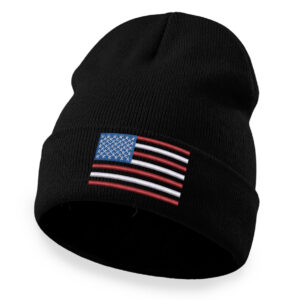
Patriotic Beanies, American Eagle & Flag Apparel, Patriotic Hats & Headwear
$24.99Select options This product has multiple variants. The options may be chosen on the product page -
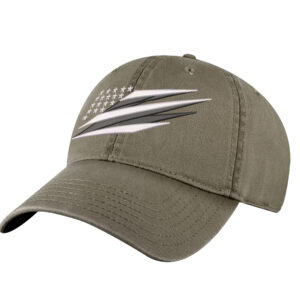
Patriotic Hats & Headwear, American Eagle & Flag Apparel, Patriotic Baseball Hats
$29.99Select options This product has multiple variants. The options may be chosen on the product page -
Patriotic Hoodies & Sweatshirts, American Eagle & Flag Apparel, Full Front Graphic Hoodies
Price range: $49.99 through $56.99Select options This product has multiple variants. The options may be chosen on the product page
Frequently Asked Questions About The Star-Spangled Banner
When did The Star-Spangled Banner become the national anthem?
Congress designated “The Star-Spangled Banner” as the national anthem in 1931, and President Herbert Hoover signed the measure into law on March 3, 1931. The song had already been used in military and public settings for decades before it received official legal status.
Who wrote The Star-Spangled Banner and why?
Francis Scott Key wrote the words after witnessing the British bombardment of Fort McHenry during the Battle of Baltimore in September 1814. When he saw the American flag still flying over the fort after the attack, he began writing the four stanzas first published as “Defence of Fort M’Henry.”
Was the Star-Spangled Banner flag the first American flag?
No. The flag that inspired Key was a 15-star, 15-stripe garrison flag made in Baltimore in 1813. It reflected the official flag design of that period and was not the first flag of the United States.
Who made the flag that flew over Fort McHenry?
Baltimore flagmaker Mary Pickersgill made the large garrison flag with help from her daughter Caroline, her nieces Eliza and Margaret Young, and Grace Wisher, a young African American indentured servant. Pickersgill’s mother, Rebecca Young, may also have assisted.
Did the large Star-Spangled Banner fly throughout the bombardment?
Not necessarily. Fort McHenry also had a smaller storm flag, and historians believe it may have been used during the rainy bombardment. The huge 30-by-42-foot garrison flag was raised on the morning of September 14, 1814, when the British attack had failed, and that is the flag Key saw.
How many verses does The Star-Spangled Banner have?
Francis Scott Key wrote four stanzas. Today the first stanza is the one normally performed as the national anthem, while the remaining stanzas are much less familiar.
What tune is The Star-Spangled Banner set to?
Key’s words were matched to “To Anacreon in Heaven,” an existing English tune associated with London’s Anacreontic Society and commonly credited to John Stafford Smith. The melody was already known in the United States before 1814.
Where is the original Star-Spangled Banner flag today?
The surviving flag is preserved and displayed at the Smithsonian’s National Museum of American History in Washington, D.C. It was originally about 30 by 42 feet, but it is now roughly 30 by 34 feet because pieces were removed over time, including as keepsakes.