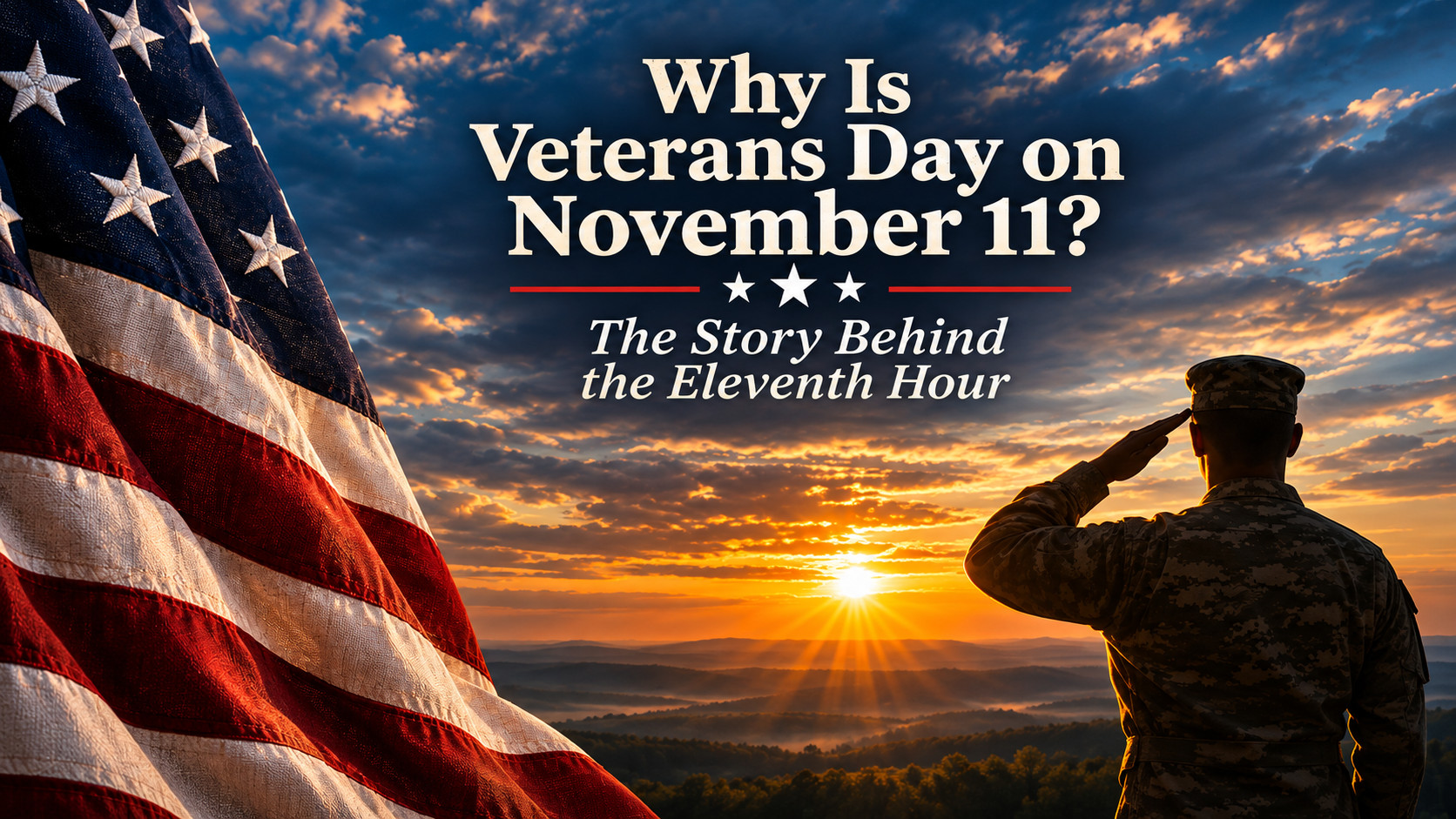
Every year on November 11, Americans pause to honor the men and women who served in the United States Armed Forces.
But why November 11?
The answer reaches back more than a century, to the final hours of World War I and a moment remembered as the eleventh hour of the eleventh day of the eleventh month.
Veterans Day did not begin as a shopping holiday, a long weekend, or even as Veterans Day. It began with the end of fighting in one of the deadliest wars the world had ever seen.
Understanding that history helps explain why November 11 still matters today.
Quick Answer: Why Is Veterans Day on November 11?
Veterans Day is observed on November 11 because the armistice that stopped the fighting in World War I took effect at 11:00 a.m. on November 11, 1918. The date became known as Armistice Day and was later renamed Veterans Day to honor American veterans of all wars.
What Happened on November 11, 1918?
By the fall of 1918, World War I had devastated Europe for more than four years.
Millions had been killed. Millions more had been wounded. Nations had exhausted enormous amounts of manpower, money, and material.
Then came November 11.
Germany and the Allied powers agreed to an armistice, a temporary cessation of hostilities. The agreement was signed earlier that morning in France, but the fighting did not stop immediately.
The armistice was scheduled to take effect at 11:00 a.m. on November 11, 1918.
That gave history one of its most memorable phrases:
The eleventh hour of the eleventh day of the eleventh month.
At that hour, the guns fell silent across much of the Western Front.
The formal peace treaty ending the war, the Treaty of Versailles, would not be signed until June 28, 1919. But November 11, 1918 became the date most closely associated with the end of World War I fighting.
The U.S. Department of Veterans Affairs notes that November 11 is generally regarded as the end of what was then called “the war to end all wars.” The Library of Congress also preserves the history of the armistice and the first American observances that followed.
Why Was It Originally Called Armistice Day?
The first anniversary came one year later.
In 1919, President Woodrow Wilson proclaimed November 11 as the first commemoration of Armistice Day.
The original observance focused on the end of World War I, remembrance of those who served, gratitude for peace, and the hope that such destruction would never happen again.
Communities marked the day with ceremonies, parades, public gatherings, and a brief suspension of business beginning at 11:00 a.m.
The significance of November 11 continued to grow.
In 1926, Congress formally recognized the anniversary. In 1938, November 11 became a legal federal holiday known as Armistice Day.
At that point, however, the holiday was still primarily associated with veterans of World War I.
History soon made that definition too narrow.
How Armistice Day Became Veterans Day
World War I had once been called the war that would end wars.
It did not.
The United States would send another generation into World War II, followed by American service members fighting in Korea and later conflicts.
By the 1950s, millions of Americans had served in wars that took place after the original Armistice Day was created.
The country needed a day that recognized more than one generation of veterans.
In 1954, Congress amended the law by replacing the word “Armistice” with “Veterans.” President Dwight D. Eisenhower approved the legislation on June 1, 1954.
Later that year, Eisenhower issued the first Veterans Day proclamation.
The date stayed the same.
The meaning became broader.
November 11 was no longer only about the end of World War I. It became a national day to honor American veterans of all wars.
Veterans Day Timeline
| Year | What Happened |
|---|---|
| 1918 | The World War I armistice took effect at 11:00 a.m. on November 11. |
| 1919 | President Woodrow Wilson proclaimed the first Armistice Day commemoration. |
| 1926 | Congress formally recognized November 11 as a day of national observance. |
| 1938 | Armistice Day became a legal federal holiday. |
| 1954 | Congress changed Armistice Day to Veterans Day to honor American veterans of all wars. |
| 1971 | Veterans Day was temporarily observed on the fourth Monday in October under the Uniform Monday Holiday law. |
| 1978 | Veterans Day returned permanently to November 11 because of the date’s historic importance. |
Was Veterans Day Ever Celebrated on a Different Date?
Yes.
In 1968, the Uniform Holiday Bill moved several federal holidays to Mondays in an effort to create more three-day weekends for federal employees.
Veterans Day was among them.
Beginning in 1971, Veterans Day was observed on the fourth Monday in October.
The change did not last.
Many states continued recognizing November 11, and veterans organizations and citizens strongly supported returning the holiday to its historically significant date.
In 1975, President Gerald Ford signed legislation restoring Veterans Day to November 11 beginning in 1978.
That history matters because November 11 was never simply a convenient place on the calendar.
The date itself tells the story.
Why Does the Eleventh Hour Still Matter?
More than a century has passed since the guns fell silent in 1918.
The generation that fought World War I is gone.
But the meaning of the eleventh hour remains.
It marks a moment when soldiers who had lived through years of artillery, trenches, mud, disease, fear, and loss finally experienced silence.
For Americans today, November 11 connects that history to every generation that followed.
- World War II
- Korea
- Vietnam
- The Persian Gulf
- Afghanistan
- Iraq
- Peacetime service around the world
Different generations wore different uniforms and faced different missions, but they share one thing: they answered the call to serve.
That is what Veterans Day asks Americans to remember.
Veterans Day Is Not Memorial Day
Veterans Day and Memorial Day are both connected to military service, but they are not interchangeable.
Veterans Day honors everyone who served in the United States Armed Forces.
Memorial Day specifically honors those who died while serving the country.
That distinction matters.
Memorial Day is centered on remembrance of the fallen. Veterans Day recognizes the broader community of American veterans and military service across generations.
For a deeper explanation, read our complete guide to Veterans Day vs. Memorial Day and why the difference matters.
Is Veterans Day Always November 11?
Yes.
Veterans Day officially remains November 11 regardless of which day of the week it falls on.
Some communities may schedule parades or local ceremonies on a nearby weekend so more people can participate, but the historic national observance remains November 11.
The date preserves the connection to the armistice of 1918 and the eleventh hour of the eleventh day of the eleventh month.
Should the American Flag Be Flown on Veterans Day?
Yes.
The United States Flag Code specifically lists Veterans Day, November 11, among the occasions when display of the American flag is especially encouraged.
Veterans Day itself does not automatically require the flag to be lowered to half-staff.
That is another area where Veterans Day can be confused with Memorial Day.
On Memorial Day, federal flag etiquette calls for the American flag to be flown at half-staff until noon and then raised to full-staff for the remainder of the day.
For Veterans Day, the flag is normally displayed at full-staff unless a separate federal, state, or other applicable half-staff directive is in effect.
You can review the federal language in 4 U.S.C. § 6.
For practical guidance at home, see our American Flag Etiquette guide.
If you need to determine who has authority to issue a half-staff order and where to verify current instructions, use the America 2 Wear 50-State Half-Staff Flag Rules and Official Alerts Guide.
How Can Americans Observe Veterans Day?
There is no single correct way to show gratitude.
Some Americans attend a parade or ceremony.
Others visit a veterans memorial, fly the flag, talk with a family member who served, support a veterans organization, or simply take the time to listen when a veteran tells a story.
One of the simplest things you can do is also one of the most important:
Know what the day means.
Veterans Day is not simply another patriotic date on the calendar.
Behind November 11 are generations of Americans who gave years of their lives to military service, often spending long periods away from their families, their homes, and the everyday freedoms most people take for granted.
A simple “thank you for your service” carries more weight when we understand the history behind it.
Why Veterans Day Still Matters
America has changed dramatically since 1918.
The military has changed.
The world has changed.
But service still requires something from the person who raises a hand and takes an oath.
- Time
- Discipline
- Responsibility
- Sacrifice
- And sometimes far more
Veterans Day gives the country one day to recognize that service across generations.
Not according to political party.
Not according to which war someone served in.
Not according to whether their service happened overseas or at home.
They served the same country.
That is worth remembering.
At America 2 Wear, we believe patriotism should carry meaning. The symbols we wear, the flag we display, and the holidays we observe become more powerful when we understand the history behind them.
Country over party. Liberty over power. Respect for those who served.
November 11 reminds us why.
Frequently Asked Questions About Veterans Day
Why is Veterans Day celebrated on November 11?
Veterans Day is celebrated on November 11 because the armistice that stopped the fighting in World War I took effect at 11:00 a.m. on November 11, 1918. The date became known as Armistice Day and later Veterans Day.
What does the eleventh hour of the eleventh day of the eleventh month mean?
It refers to 11:00 a.m. on November 11, 1918, when the World War I armistice took effect and fighting ceased along much of the Western Front.
Was Veterans Day originally called Armistice Day?
Yes. November 11 was originally commemorated as Armistice Day in remembrance of the end of World War I fighting. Congress changed the holiday’s name to Veterans Day in 1954 so it could honor American veterans of all wars.
Who changed Armistice Day to Veterans Day?
Congress passed legislation changing the name, and President Dwight D. Eisenhower approved it on June 1, 1954. Eisenhower issued the first Veterans Day proclamation later that year.
Is Veterans Day always on November 11?
Yes. Veterans Day officially falls on November 11 regardless of the day of the week. Some local ceremonies may be held on nearby weekends for convenience.
What is the difference between Veterans Day and Memorial Day?
Veterans Day honors everyone who served in the United States Armed Forces. Memorial Day specifically honors military personnel who died while serving the country. Read our full Veterans Day vs. Memorial Day guide for more detail.
Should the flag be at half-staff on Veterans Day?
Not automatically. Veterans Day itself does not require the American flag to be flown at half-staff. A separate presidential, gubernatorial, or other applicable directive could still call for half-staff display because of another event.
Why was Veterans Day moved to October?
The Uniform Holiday Bill moved Veterans Day to the fourth Monday in October beginning in 1971 as part of an effort to create several three-day federal holiday weekends. Because November 11 carried strong historical significance, legislation later restored Veterans Day to its traditional date beginning in 1978.